Every job runs the same way, from a single core to a run of openings across a building. Enquiry, survey, scan, choose the method, control the dust and water, do the work, make good, hand it back tidy, and deal with the waste. Here is what each of those steps actually involves.
Your diamond drilling enquiry
It starts with a call or a message. The detail we want up front is simple: what needs drilling or cutting, the sizes, the material, and where the site is.
If you have drawings, send them. If you do not, a few photos and the rough dimensions get us a long way. We respond to every enquiry, usually the same working day, and we will tell you straight whether it is a job we can help with and what we need to see next.
The survey before any drilling starts
On most jobs we survey the site before we price. A quote given without seeing the work is a guess, and guesses turn into arguments once the rig is set up.

The survey confirms the material and its thickness, the hole or cut positions, the orientation, and the access. We check whether power and water are on site or need bringing. We look at what has to be protected, how waste leaves, and the hours the building allows. That is where the real price comes from, and the survey is free.
Scanning before we cut
Concrete hides things. Reinforcement, post-tension cables, conduit, drainage and live services all sit inside a slab or wall where you cannot see them. Cutting one of those blind is expensive and dangerous.
So where there is any risk, we use concrete scanning for rebar and buried services before a barrel touches it. The setting out is then adjusted to keep the core or the cut clear of anything critical. Scanning first is far cheaper than a service strike or a cracked structural member.
Choosing the method: diamond drill or saw
Round holes get drilled. Straight lines get sawn. That is the simple version, and most jobs fall cleanly into one or the other.
A penetration for a pipe, duct, cable or fixing is diamond drilling in Essex work, with the barrel fed on an anchored rig. An opening with straight edges, a trench in a slab or a section to remove is sawing work, floor saw or wall saw depending on the face. Where an opening is too large or awkwardly placed for a saw to run, we form it with overlapping cores using stitch drilling. We pick the method that gives the cleanest result for the least disturbance, and we tell you why we have chosen it.
Dust and water control while drilling
Cutting concrete releases respirable crystalline silica. That is a controlled health risk on site, not a nuisance to shrug off, and it drives how we work.
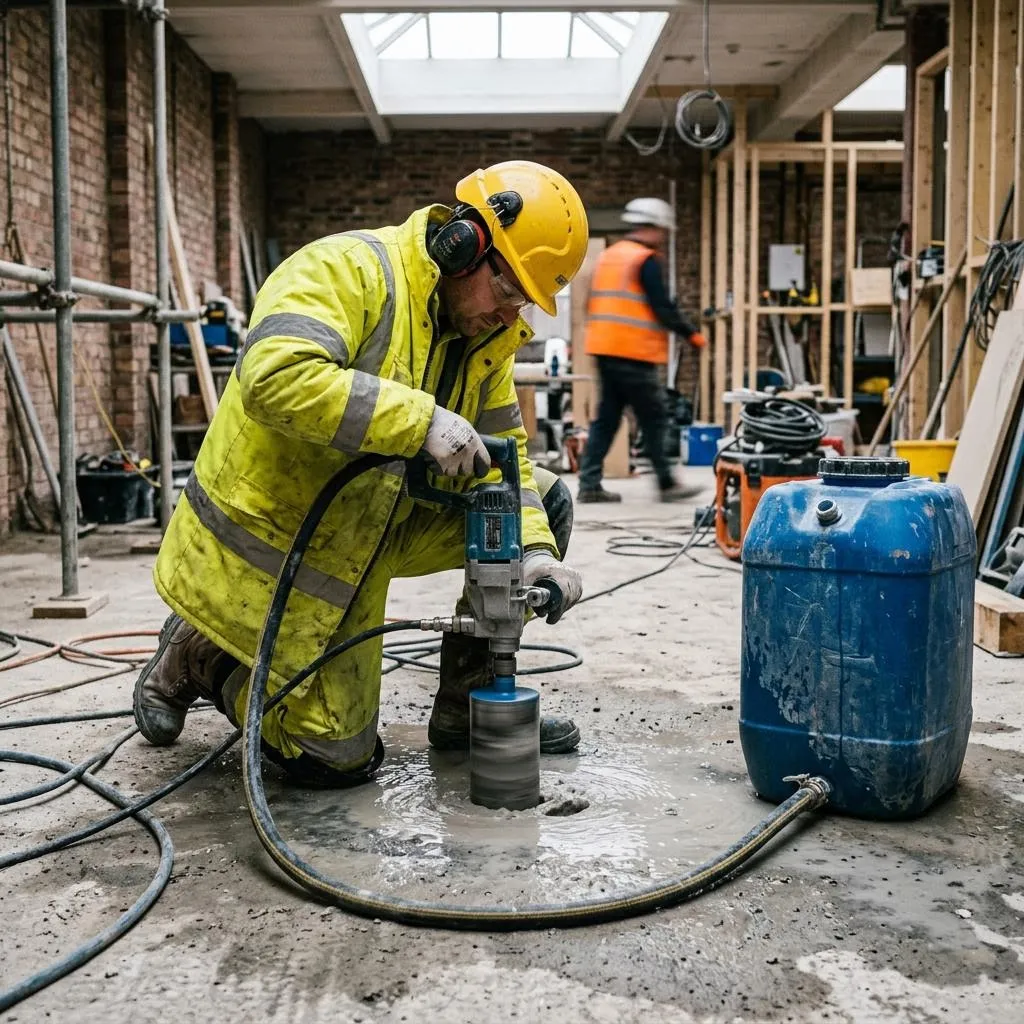
We run water-fed suppression on coring and wet cutting, so the fines are bound in slurry rather than thrown into the air. We follow the control principles in the HSE guidance on silica dust, construction information sheet CN8, which sets out water suppression, extraction and respiratory protection for this kind of work.
On cores where the finish matters, a collection ring and a vacuum catch the slurry at the hole so nothing runs across a floor. On larger runs we agree a slurry handling method with you before we start.
How the diamond drilling is carried out
With the survey done and the method chosen, the work is quick. A 152mm core through a 300mm reinforced slab takes about twenty minutes once the rig is anchored, levelled and aligned.
Drilling rigs are anchored to the structure so the cut stays true. Saws run on tracks or a floor frame for a straight, controlled line. Everything is non-percussive and low vibration, which is why it suits occupied buildings, slab edges and thin sections where a breaker would risk cracking. We keep other trades working around us wherever the sequence allows.
Making good after drilling and sawing
Diamond drilling and sawing leave clean, square edges, so making good is minimal compared with breaking out. A cored hole is smooth-walled and sized to the millimetre, ready for the pipe, duct or fixing to seat.
We will be clear about where our work stops. Forming the opening or the hole is ours. Fire-stopping, sealing, plastering, screeding and decoration are usually the following trade, unless we have agreed otherwise in writing. We say so at quote stage so there is no assumption either way.
A tidy handover
We leave the openings ready for the next trade and the area cleaned down. On an occupied site that matters as much as the cut itself, because the people using the building are still there while we work.
Cores are removed, slurry is cleared to the method agreed, and protection comes up. You get the work handed back in a state you can carry on from straight away.
Waste and cores
The cut cylinders, offcuts and slurry all have to be dealt with properly. Where a slab section is removed, it is broken to a movable size and taken out rather than left for someone else to trip over.
We agree before we start who removes what, whether a skip is on site, and how slurry is contained. Sorting that at survey stage keeps the handover clean and stops waste becoming an argument at the end.
If you want a sense of what a job like yours costs before you commit, our diamond drilling cost guide for Essex sets out the published national ranges and the drivers that move the price.
Ready to talk through your job?
Tell us what needs drilling or cutting, the sizes and the site location. We respond to every enquiry, usually the same working day, and we survey before we quote.
Or send the details over
My Diamond Drilling Essex covers the county from our Leigh-on-Sea base.