Concrete cutting covers the diamond methods used to cut, open and remove concrete cleanly: floor sawing, wall sawing and wire sawing. We cut slabs, walls and heavy reinforced sections across Essex, without the shock and cracking a breaker would cause.
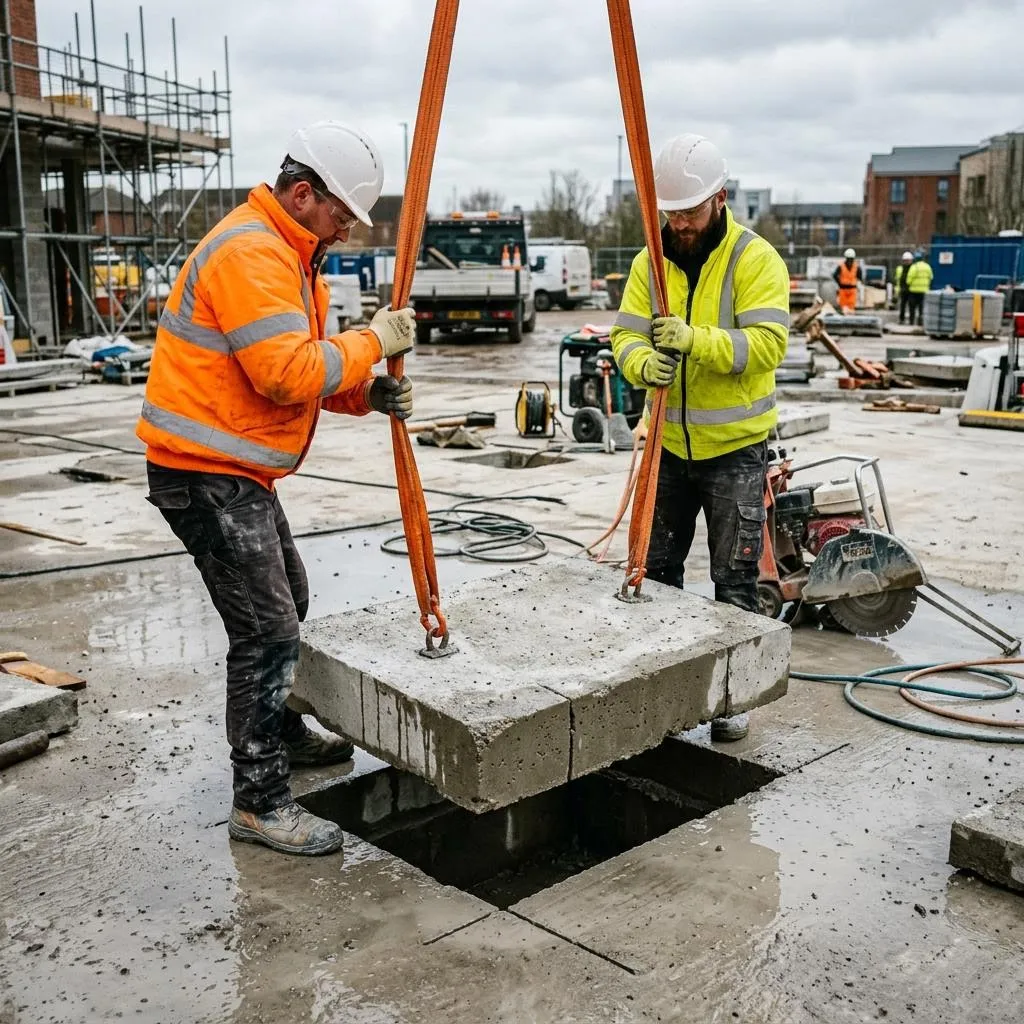
What is concrete cutting and how does it work?
Concrete cutting is the family of diamond sawing methods that cut a straight, controlled line through concrete, brick or stone. A diamond blade or wire cuts the material with water feeding the cutting face.
It is an umbrella term. Underneath it sit three methods, each suited to a different type of cut, and part of our job is choosing the right one for the access and the finish you need.
Because diamond tooling abrades rather than hammers, the surrounding structure is left intact. Clean edges, square corners, no spalled faces.
The concrete cutting methods we use
Floor sawing is for horizontal work. A self-propelled saw runs a blade down into a slab, road or yard for trenches, expansion joints and slab removal. Our floor sawing service for slabs, roads and yards goes into the depths and applications in detail.
Wall sawing, also called track sawing, mounts a blade on a track fixed to the face of a wall. It cuts precise vertical and horizontal lines for doorways, window openings and wall removals, on the flat and overhead.
Wire sawing rigs a diamond wire around a section and pulls it through. It is the method for thick reinforced sections, bases and beams that are beyond the reach of any blade.
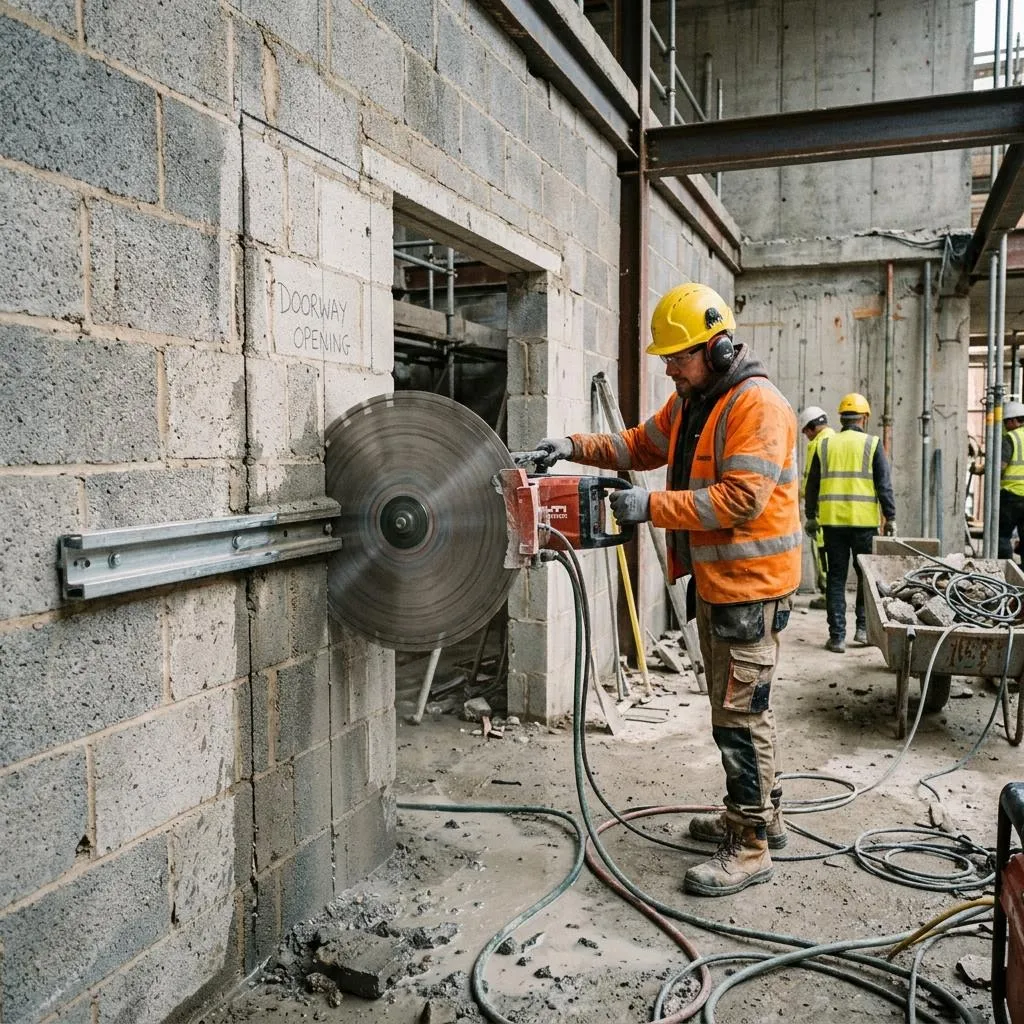
When do you need concrete cutting?
Whenever concrete has to be opened, divided or removed to a line rather than smashed out. The list is long.
Trenches for new drainage and services, expansion joints in a new slab, doorways and window openings in structural walls, lift and stair openings, and the removal of redundant bases and plinths. Anywhere the cut has to be accurate and the neighbouring structure has to survive intact.
What concrete can we cut, and to what depth?
We cut reinforced concrete, mass concrete, brickwork, blockwork, stone and tarmac. Diamond tooling cuts straight through reinforcement without stopping.
A floor saw reaches around 450mm to 500mm deep depending on blade size. A track-mounted wall saw cuts deeper, and diamond wire has no practical depth limit, which is why we reach for it on thick bases and heavy beams.
Keeping concrete cutting clean and safe
Cutting concrete releases respirable crystalline silica. We cut wet so the water feed binds the dust into slurry at the blade or wire rather than letting it go airborne.
We follow the control principles in the HSE silica dust guidance, construction information sheet CN8, which covers water suppression, extraction and respiratory protection. Slurry is contained and collected wherever it must not reach a finished surface or a drain.
Choosing the right cutting method
The method follows the geometry of the cut and the access, not the other way round. A horizontal surface calls for a floor saw. A vertical face calls for a wall saw on track.
A floor saw is quick and economical across open slab, but it only cuts downward into a flat surface. A track-mounted wall saw handles openings and overhead cuts a floor saw cannot reach, and it cuts deeper than a hand saw can safely manage.
Wire sawing is the answer when a section is too thick, too heavily reinforced or too awkward for any blade. The wire wraps the section and pulls through from both sides, which is why it is used on bases, bridge beams and mass concrete. On many jobs we combine methods, sawing the faces and finishing the corners with a line of stitch drilled holes where a blade cannot overrun.
Who we cut concrete for
Concrete cutting spans new build, refurbishment and civils, so our clients range from groundworkers to fit-out contractors.
We cut for main contractors forming openings and joints, for groundworkers trenching slabs and yards for new drainage, and for M and E contractors creating routes for services. Demolition and strip out contractors use us for controlled section removal where breaking out is not an option, close to party walls or occupied space.
Our concrete cutting process, step by step
We survey the site, confirm access, power and water, and agree the method, the cut lines and how any removed sections will be lifted out.
We scan the concrete where reinforcement or services could be in the cut path, set out the lines, then rig the saw or wire and cut wet with slurry control in place.
We break the section down to liftable pieces, remove them, and clean down so the opening or trench is ready for the following trade.
Where we carry out concrete cutting in Essex
We cover Essex from Leigh-on-Sea, from Thames-side industrial units to the county towns.
That includes slab and trench work on concrete cutting in Grays and the distribution sites there, and structural openings on jobs across Basildon and its commercial estates. Southend, Chelmsford, Rayleigh, Benfleet, Canvey Island and Brentwood are all within our normal working area.
Concrete cutting FAQs
What concrete cutting methods do you use?
Three main methods: floor sawing for horizontal slabs, roads and yards, wall sawing on a track for walls and openings, and wire sawing for thick or awkward reinforced sections beyond blade reach. We choose the method to suit the cut, the access and the finish.
How thick a section can you cut?
A floor saw handles slab depths up to around 450mm to 500mm depending on the blade. A track-mounted wall saw cuts deeper still, and where a section is too thick for a blade we rig a diamond wire, which has no practical depth limit.
Will cutting shake or crack the surrounding structure?
No. Diamond blades and wire cut the concrete rather than hammering it, so there is very little vibration compared with a breaker. That is why these methods are used in occupied buildings and close to sensitive finishes and edges.
How do you control the dust and slurry?
We cut wet. Water feeds the blade or wire, binding the fines into slurry so respirable silica is suppressed at source, and we collect the slurry where it must not spread across a floor or into a drain.
Can you cut and remove a section in one visit?
Often, yes. We size the cuts so the pieces can be lifted or barrowed out through the available access. On heavy sections we plan the lift and craneage before we cut so nothing is stranded once it is free.
Need concrete cut or removed in Essex?
Tell us what needs cutting, the section sizes and the access. We survey before we quote and respond to every enquiry, usually the same working day.
Or send the details over
My Diamond Drilling Essex covers the county from our Leigh-on-Sea base.