Wall sawing, also called track sawing, cuts straight, deep, accurate lines through structural walls for doorways, windows and openings. We wall saw across Essex through reinforced concrete and masonry, with the blade running on a track so the cut stays true and square.
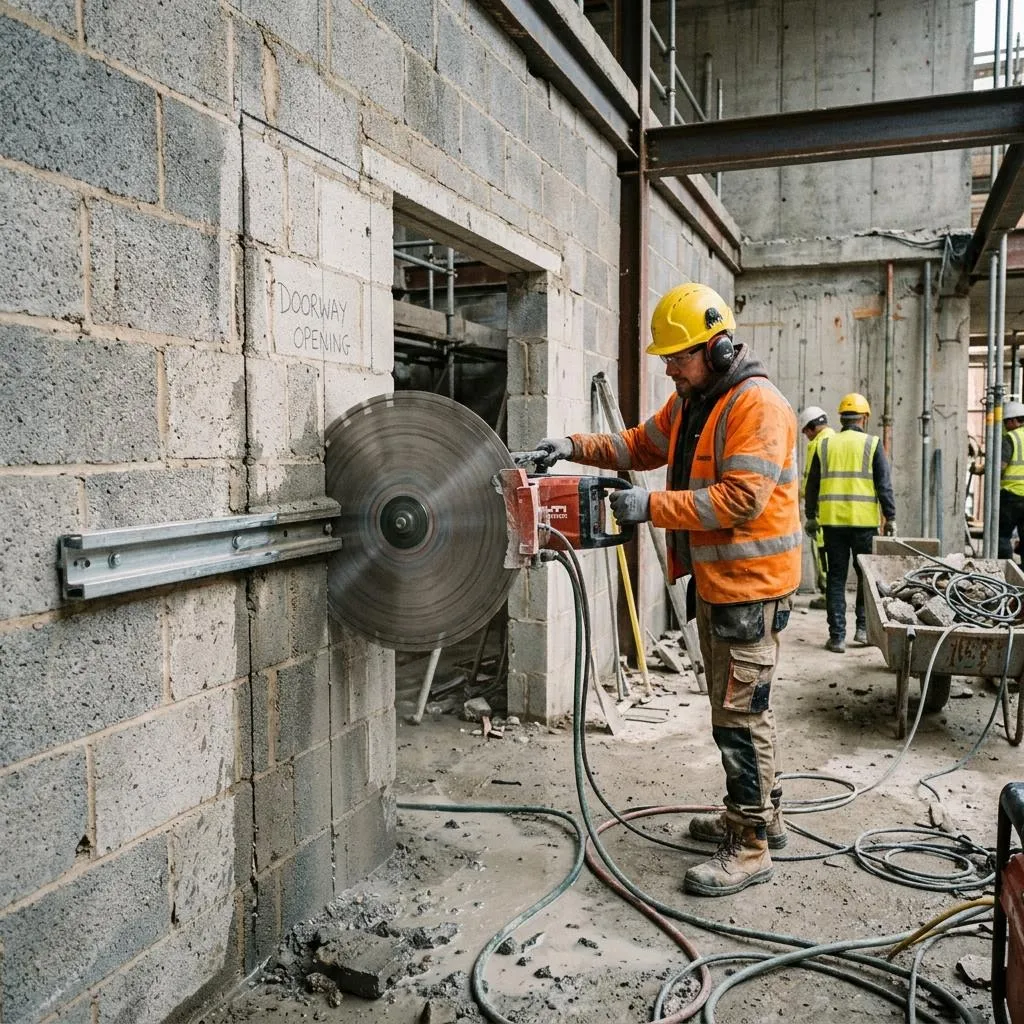
What is wall sawing and how does it work?
Wall sawing is a diamond cutting method for vertical and inclined surfaces. A powered saw head carries a diamond blade and runs along a track that is bolted to the wall, so the blade follows a fixed, straight line.
Because the head is guided by the track rather than held by hand, the cut is dead straight and to a controlled depth. This is why the UK trade term track sawing is used interchangeably: the track is what turns a rough cut into a precise one.
The blade is water cooled throughout, which keeps it running and suppresses the dust. The result is a clean-faced opening with square edges, ready to frame a door, a window or a service penetration.
When do you need wall sawing?
You need it whenever an opening in a wall has to be straight, sized and cut without hammering the structure. It is the standard method for forming openings in concrete and heavy masonry.
Typical work includes new doorways, window openings, serving hatches and ventilation openings in structural walls. It covers cutting down existing openings to a new size, forming openings for structural openings such as lift shafts and stairs, and cutting sections of wall out for removal.
It is the right choice in occupied buildings, near existing finishes and on party walls, because the low vibration and controlled dust keep the disruption down where a breaker would cause complaints and cracking.
What can we wall saw, and to what depth?
We wall saw reinforced concrete, post-tensioned sections, mass concrete, engineering brick, blockwork and stone. The diamond blade cuts straight through reinforcement without stalling.
Cut depth from a single face typically runs between 300mm and 600mm depending on the blade diameter fitted. Cutting from both faces of a through wall roughly doubles the reach, so most structural walls are within range. Wall sawing is one of the methods grouped under our wider concrete cutting service across Essex, which also covers floor and wire sawing for sections a track saw cannot handle.
Openings are cut to your marked size. Corners that a round blade cannot fully reach are finished with a short overcut or with stitch drilling, so the opening comes out square rather than with radiused corners left in.
Keeping wall sawing clean and safe
Cutting concrete releases respirable crystalline silica. The water that cools a wall saw blade also binds the dust into slurry at source, so it is suppressed rather than sent airborne across the site.
We work to the control principles in the HSE guidance on silica dust, construction information sheet CN8, which covers water suppression, extraction and respiratory protection. On jobs where the finish matters we catch the slurry at the cut with collection and vacuum so nothing runs onto a floor below.
Where an opening removes load-bearing material, the temporary works, propping and any new support are the responsibility of the client's engineer, and must be designed and in place before we cut. We cut to the approved opening and do not design the support ourselves.
Our wall sawing process, step by step
First we survey and set out. We confirm access, power and water, mark the opening to your drawing, and scan the wall where there is any risk of cutting a critical bar or a live service.
Next we fix the track and cut. The track is bolted to the wall on line, the saw head is fitted, the water feed is connected, and each side of the opening is cut to depth.
Then we complete the corners and remove the section. Corners are overcut or stitch drilled, and the panel is taken out whole or broken into liftable pieces where it is heavy.
Finally we clear the slurry and debris, clean down, and leave the opening ready for the following trade to frame or make good.
Where we carry out wall sawing in Essex
We wall saw across Essex from our base in Leigh-on-Sea, covering the coastal towns, the Thames-side industrial areas and the county towns inland.
Southend, Basildon, Chelmsford, Grays, Rayleigh, Benfleet, Canvey Island and Brentwood are all within our normal working area, along with the towns in between. Refurbishment, extension and fit-out work, where new openings are formed in existing walls, keeps wall sawing in steady demand across the county.
Wall sawing FAQs
Is wall sawing the same as track sawing?
They are the same thing, and both terms are in normal UK use. The saw head runs along a track bolted to the wall, driving a diamond blade through the concrete on a fixed line. Some contractors call it wall sawing, others call it track sawing, because the track is what makes the cut straight and controlled.
How deep can a wall saw cut?
Depth depends on the blade diameter. A wall saw typically cuts to somewhere between 300mm and 600mm from one face depending on the blade fitted, and by cutting from both faces on a through wall the combined depth is greater. Where a section is thicker than a blade can reach we move to wire sawing instead.
Can you cut a doorway or window opening in a concrete wall?
Yes, that is the most common wall sawing job. The track lets us cut the perimeter of a doorway, window or serving hatch on a dead straight line, so the opening comes out square and to size. Corners are completed with an overcut or with stitch drilling where the blade cannot fully reach the corner.
Does wall sawing need water, and where does it go?
Yes. The blade is water cooled, which also suppresses the dust. That produces slurry, so on any job where the finish matters we control it at the cut with collection and vacuum so it does not run across a floor. On external walls we agree how the water is caught and disposed of before we start.
Will the wall be safe once the opening is cut?
That is a temporary works question, and it is decided by your structural engineer, not by us. Where an opening removes load-bearing material, the propping and any lintel or new support must be designed and in place before we cut. We cut to the approved opening; we do not design the support.
Need an opening cut cleanly through a wall?
Send the opening size, the wall build-up and the site location. We respond to every enquiry, usually the same working day, and we survey before we quote.
Or send the details over
My Diamond Drilling Essex covers the county from our Leigh-on-Sea base.