Stitch drilling forms an opening from a line of overlapping cores, so you get a slot or a hole shape where a saw simply cannot run. We stitch drill across Essex to cut openings in reinforced concrete walls, slabs and beams when access is too tight for a blade.
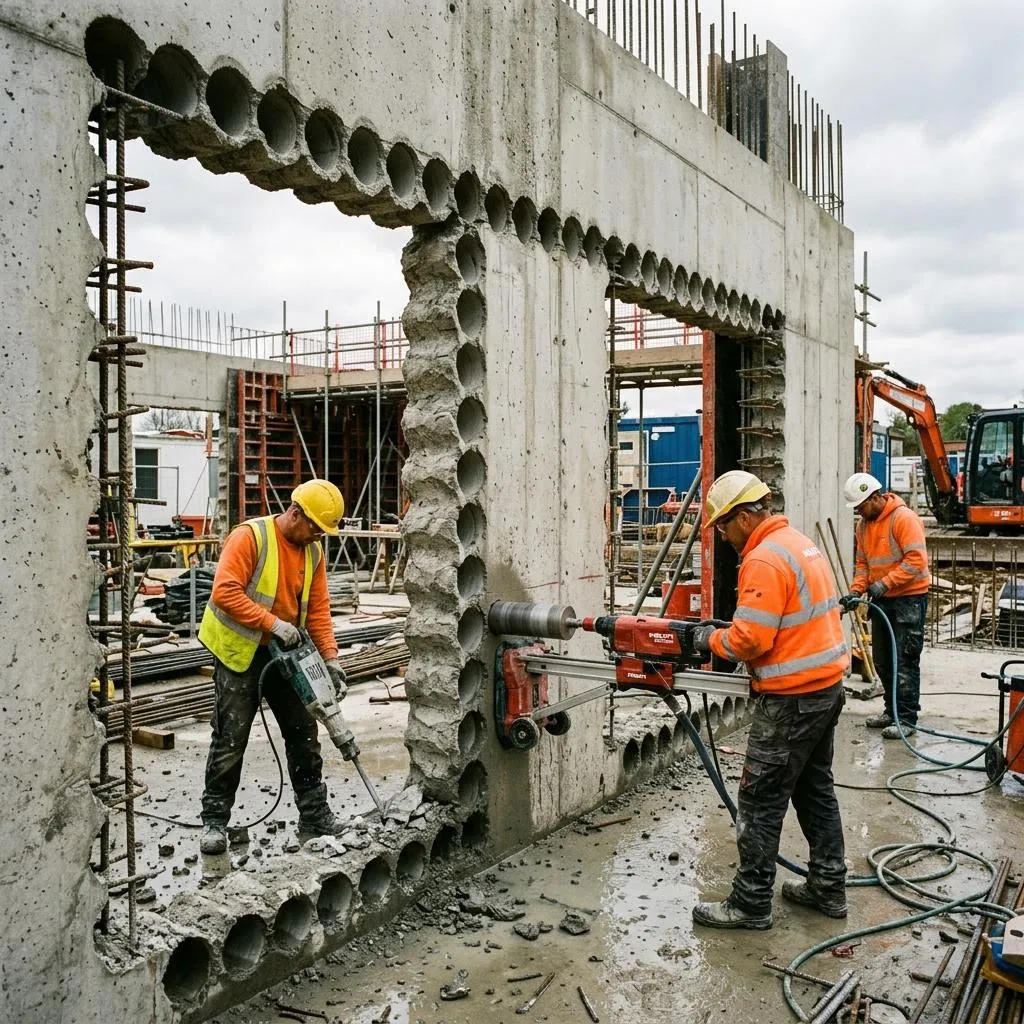
What is stitch drilling and how does it work?
Stitch drilling is a coring method that removes material in a line rather than a single round hole. A series of cores is drilled so each one overlaps the last, and the web of concrete between them comes out with the cores.
The barrel is the same diamond core barrel used for ordinary drilling, mounted on a rig anchored to the structure. Because the holes overlap, the finished edge is a run of shallow scallops that together define a straight slot, a corner or a full opening.
It is a way of cutting a shape into concrete using drilling kit alone. That matters where a saw head, its guard and its track will not physically fit, which is more common on real sites than the tidy drawings suggest.
When do you need stitch drilling?
You need it whenever an opening has to be cut but a blade cannot reach the line. That is the core case, and it comes up constantly in refurbishment.
Typical work includes openings that run into a corner, where a circular saw blade cannot complete the cut without overrunning. It covers deep sections beyond the plunge depth of a wall saw, openings in restricted headroom, and slots formed against a return wall or an existing structure.
It is also the method for forming an opening in stages when the far side is inaccessible, or when a heavy section has to be broken into smaller, liftable pieces before removal. The overlapping cores define exactly where those breaks fall.
What can we stitch drill and to what size?
We stitch drill through reinforced concrete, post-tensioned slabs, mass concrete, engineering brick, blockwork and masonry. The diamond segments cut reinforcement, mesh and lacing bars without stalling.
Core diameters for stitch work usually run in the 50mm to 200mm range, chosen to suit the wall thickness and the shape being formed. Smaller cores give a tighter corner radius, larger cores clear material faster on a long straight run. The overlap is set so no uncut web is left between holes.
Openings themselves have no fixed size limit because the method is repeatable along any line you mark. Stitch drilling uses the same barrels and rigs as our My Diamond Drilling Essex rigs for drilling through reinforced concrete, so the two are often run on the same visit.
Keeping stitch drilling clean and safe
Cutting concrete releases respirable crystalline silica, a controlled health risk on site. Wet stitch drilling suppresses that dust at source, because the water feed keeps the fines bound in slurry rather than airborne.
We work to the control principles in the HSE guidance on silica dust, construction information sheet CN8, which sets out water suppression, on-tool extraction and respiratory protection for this kind of work. On openings above head height we add slurry control at the cores so nothing runs back down the face.
Before we drill near reinforcement or buried services we scan the concrete first, so the line of cores is set out clear of anything critical. Stitch drilling produces a run of core slugs, which we remove and clear to the method agreed with you before we start.
Our stitch drilling process, step by step
First we survey and set out. We confirm access, power and water, mark the opening to your drawing, and scan the area where there is any risk of cutting a critical bar or a live service.
Next we rig and drill the perimeter cores. The rig is anchored, levelled and aligned, and each core is taken so it overlaps its neighbour along the marked line. The water feed runs throughout.
Then we remove the section. On small openings the cored panel comes out in one piece. On larger or heavier openings we break it into liftable sections, which is where forming the opening as part of a wider structural opening in a load-bearing wall needs the client's temporary works and propping already in place.
Finally we clear the cores and slurry, clean down, and leave the opening ready for the following trade to box out or make good.
Where we carry out stitch drilling in Essex
We work across Essex from our base in Leigh-on-Sea, covering the coastal towns, the Thames-side industrial areas and the county towns inland.
Southend, Basildon, Chelmsford, Grays, Rayleigh, Benfleet, Canvey Island and Brentwood are all within our normal working area, along with the towns in between. Refurbishment and fit-out work, where openings so often land in awkward corners, keeps stitch drilling in regular demand right across the county.
Stitch drilling FAQs
What is the difference between stitch drilling and coring a single hole?
A single core takes out one clean cylinder. Stitch drilling takes out a line of overlapping cylinders, so the material between the holes is removed as well. The result is a slot or an opening rather than a round hole. It is really a way of using the same coring kit to cut a shape a saw could not reach.
When would you stitch drill instead of wall sawing?
Wherever a saw cannot run its blade or track. That covers deep sections beyond blade reach, tight corners where a saw head will not fit, openings against a return wall, and work in restricted headroom. Stitch drilling reaches into those places because the rig footprint is small and the barrel does the cutting, not a spinning blade.
How thick a section can you stitch drill through?
Thickness is rarely the limit. Barrels can be extended and the cores taken in stages, so we stitch through thick walls and deep slabs. On very deep sections we may combine stitch drilling with wire sawing, where the wire takes over once a start hole is in.
Are the cut edges clean enough to leave exposed?
The edge follows the scallop line of the overlapping cores, so it is a series of shallow curves rather than a dead straight face. For most builders work openings that gets boxed out or made good it is perfectly acceptable. Where a razor-straight edge matters we discuss sawing the face after the opening is out.
Does stitch drilling cause vibration or cracking?
No. Each core is cut by rotating diamond segments rather than by any percussive action, so the section is not shock loaded. That is why stitch drilling suits openings near slab edges, in thin returns and in occupied buildings where a breaker would risk cracking.
Need an opening cut where a saw cannot reach?
Send the opening size, the wall thickness and the site location. We respond to every enquiry, usually the same working day, and we survey before we quote.
Or send the details over
My Diamond Drilling Essex covers the county from our Leigh-on-Sea base.