Wire sawing cuts through deep, thick and awkward concrete sections that no fixed blade can reach, using a loop of diamond wire driven around the section. We wire saw across Essex on mass concrete, heavy beams, columns and foundations where the material is simply too big for a saw.
What is wire sawing and how does it work?
Wire sawing is a diamond cutting method that uses a flexible cable instead of a rigid blade. The wire is a steel cable strung with diamond-impregnated beads, looped around the section and driven at speed by a powered flywheel.
As the loop tightens and runs, the beads abrade a path through the concrete. Because the wire is flexible, the loop can be routed around a beam, a column or a buried section that a straight blade could never approach.
The cut is water cooled to control heat and dust. The method is non-percussive like the rest of our concrete cutting methods across Essex, so the section is not shock loaded, which matters when the thing being cut is holding weight until the moment it comes free.
When do you need wire sawing?
You need it whenever the section to be cut is beyond the reach of a blade, which usually means thick, deep, heavily reinforced or an awkward shape. It is the method for the jobs the other saws cannot do.
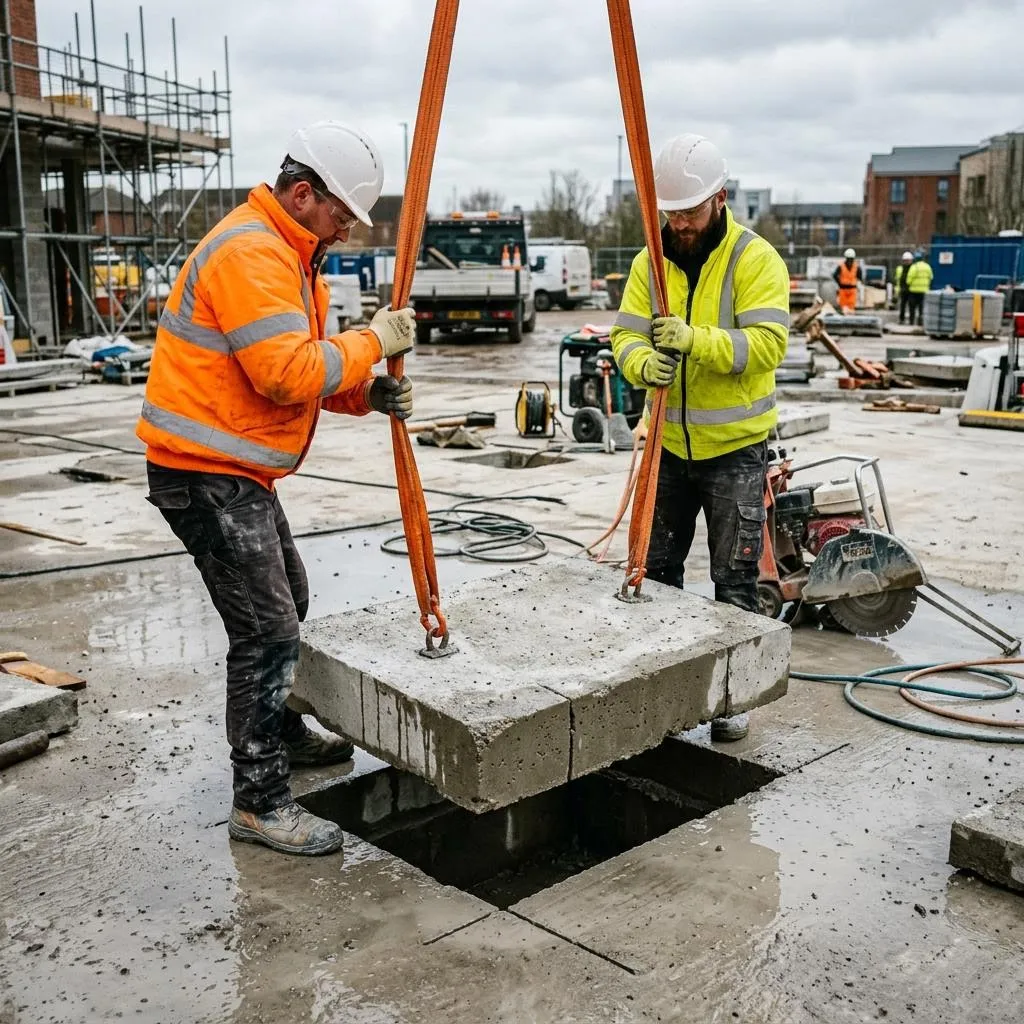
Typical work includes mass concrete foundations and bases, thick retaining walls, heavy transfer beams, reinforced columns, and bridge and marine structures. It also covers cutting large sections free for a controlled lift.
It comes into its own on removal and demolition, where wire sawing lets a heavy element be cut into pieces sized for the crane or excavator, so the structure is dismantled in a planned sequence rather than knocked down.
What can we wire saw, and to what size?
We wire saw reinforced concrete, mass concrete, post-tensioned sections, heavy masonry and stone. The diamond wire cuts through dense reinforcement without the stalling that limits a blade.
There is no practical thickness limit for the sections we handle, because the wire loop can be made any size. Thick foundations, deep walls, large columns and heavy beams are all routine. What governs the job is the rigging, the access for the wire and flywheel, and how the cut piece is going to be lifted away.
On the heaviest removal work, wire sawing sits alongside our controlled demolition, bursting and cut-and-lift methods, which together take a structure apart in pieces rather than bringing it down in one go.
Keeping wire sawing clean and safe
Wire sawing is water cooled, and that water suppresses the dust from cutting concrete at source, keeping the respirable silica bound in slurry rather than airborne. The wire itself runs inside guarding for the duration of the cut.
On the heaviest sections the real safety question is control of the piece being cut. We plan the cut sequence and the lift together, so the section is supported or restrained right up to the point it comes free, and never left to move unexpectedly.
Where the work forms part of a demolition, the method and sequence follow recognised demolition practice, and heavy lifting is planned with the client and the lifting contractor before the wire ever goes on. Nothing is cut until it is clear where it is going.
Our wire sawing process, step by step
First we survey and plan. We assess the section, the reinforcement, the access for the wire and drive unit, and crucially how the cut piece will be lifted or lowered away.
Next we rig the wire. Pulley and drive positions are set, feed holes are drilled where the wire has to pass through the structure, and the loop is threaded and tensioned around the cut line.
Then we cut. The wire is driven and fed through the section with the water running, the tension managed as the cut opens up, and the piece supported as it comes free.
Finally the section is lifted or lowered clear by the agreed method, the area is cleared and cleaned down, and the structure is left ready for the next stage of the works.
Where we carry out wire sawing in Essex
We wire saw across Essex from our base in Leigh-on-Sea, covering the coastal towns, the Thames-side industrial areas and the county towns inland.
Southend, Basildon, Chelmsford, Grays, Rayleigh, Benfleet, Canvey Island and Brentwood are all within our normal working area, along with the towns in between. The industrial and infrastructure stock along the Thames corridor, with its heavy bases and thick sections, is where wire sawing earns its keep.
Wire sawing FAQs
What is diamond wire sawing?
A diamond wire is a steel cable threaded with diamond beads. It is looped around the section to be cut and driven at speed by a powered wheel, so the wire abrades its way through the concrete. Because a loop of wire can be routed around almost anything, it cuts sections that no fixed blade could reach.
When would you wire saw instead of using a wall saw?
When the section is too thick or too awkward for a blade. A wall saw is limited by its blade diameter, so once a wall, a beam or a foundation is deeper than that, wire sawing takes over. It also suits mass concrete, reinforced columns, bridge sections and anything with an irregular shape a straight blade cannot follow.
Is there a limit on the thickness wire sawing can handle?
In practice, no meaningful limit for the work we do. The wire cuts a loop of any size, so mass concrete bases, thick retaining walls, heavy beams and large columns are all within reach. The larger the section, the more it is about rigging the wire correctly and managing the cut, which is where the skill sits.
Is wire sawing safe near occupied areas?
It is non-percussive and low vibration, like our other diamond methods, so it does not shock load the structure or the building around it. The wire runs inside guards, and the cut is water cooled to control heat and dust. It is a controlled way of removing heavy sections without hammering.
How is the cut section removed once the cut is complete?
That is planned before the cut, not after. Heavy sections are cut into pieces sized for the lifting method available, whether that is a crane, an excavator or manual handling in small pieces. On demolition work the wire cut is one part of a sequence that ends with the section lifted out clear of everything around it.
Got a section too thick for a saw?
Send the section size, what it is made of and how it needs to come out. We respond to every enquiry, usually the same working day, and we survey before we quote.
Or send the details over
My Diamond Drilling Essex covers the county from our Leigh-on-Sea base.