Floor sawing cuts a straight, clean line down into a horizontal surface: slabs, roads, yards and hardstandings. We use it across Essex for drainage and service trenches, expansion joints and cutting slabs into sections for removal, all without hammering the surrounding surface.
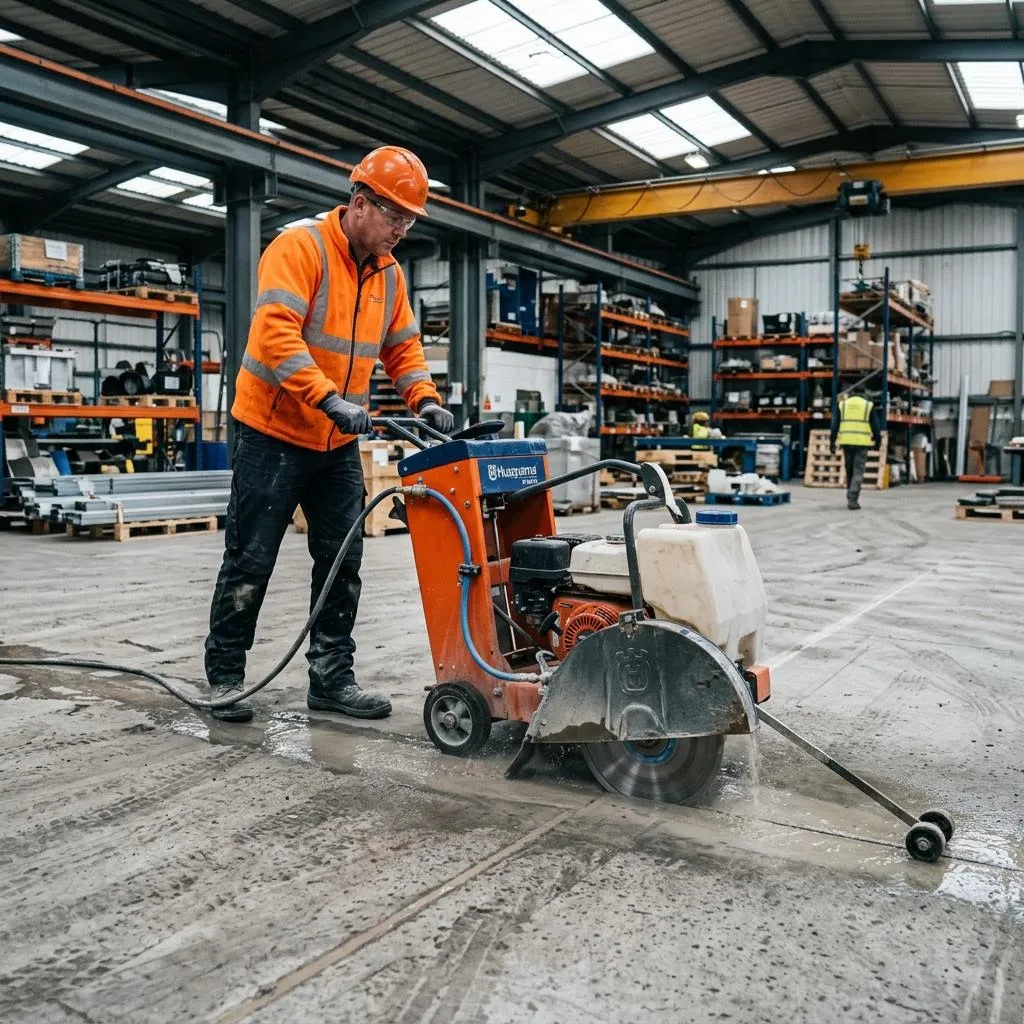
What is floor sawing and how does it work?
Floor sawing uses a self-propelled saw that runs a large diamond blade down into a horizontal surface. The operative guides it along a marked line while water feeds the blade.
The machine carries its own weight on wheels, so the blade stays at a set depth and the cut runs straight. That is why floor sawing gives a far cleaner, more accurate result than breaking a line out.
In UK trade terms this is floor sawing. It is the standard method for cutting into slabs, roads and yards wherever a horizontal cut is needed.
When do you need floor sawing?
Whenever a horizontal surface has to be cut to a line. The cut comes before the dig, the joint or the lift.
Common jobs are trenches for new drainage, water, gas and ducting; expansion and stress-relief joints in new slabs; cutting out failed slab bays for repair; and dividing a slab into pieces small enough to lift. Yards, car parks, warehouse floors and access roads all fall to a floor saw.
Where a slab is being taken up wholesale, floor sawing is the first stage of a wider concrete cutting and slab removal project, with the sawn pieces then lifted or barrowed out.
What can we floor saw, and to what depth?
We floor saw reinforced concrete, mass concrete and tarmac. The diamond blade cuts straight through mesh and reinforcing bars without stalling.
Depth in a single pass is typically around 450mm to 500mm, set by the blade diameter and the machine. Deeper cuts are made by stepping the blade down in passes. Where a slab or base is thicker than a floor saw can reach, we move to a wire saw for deep and heavy sections.
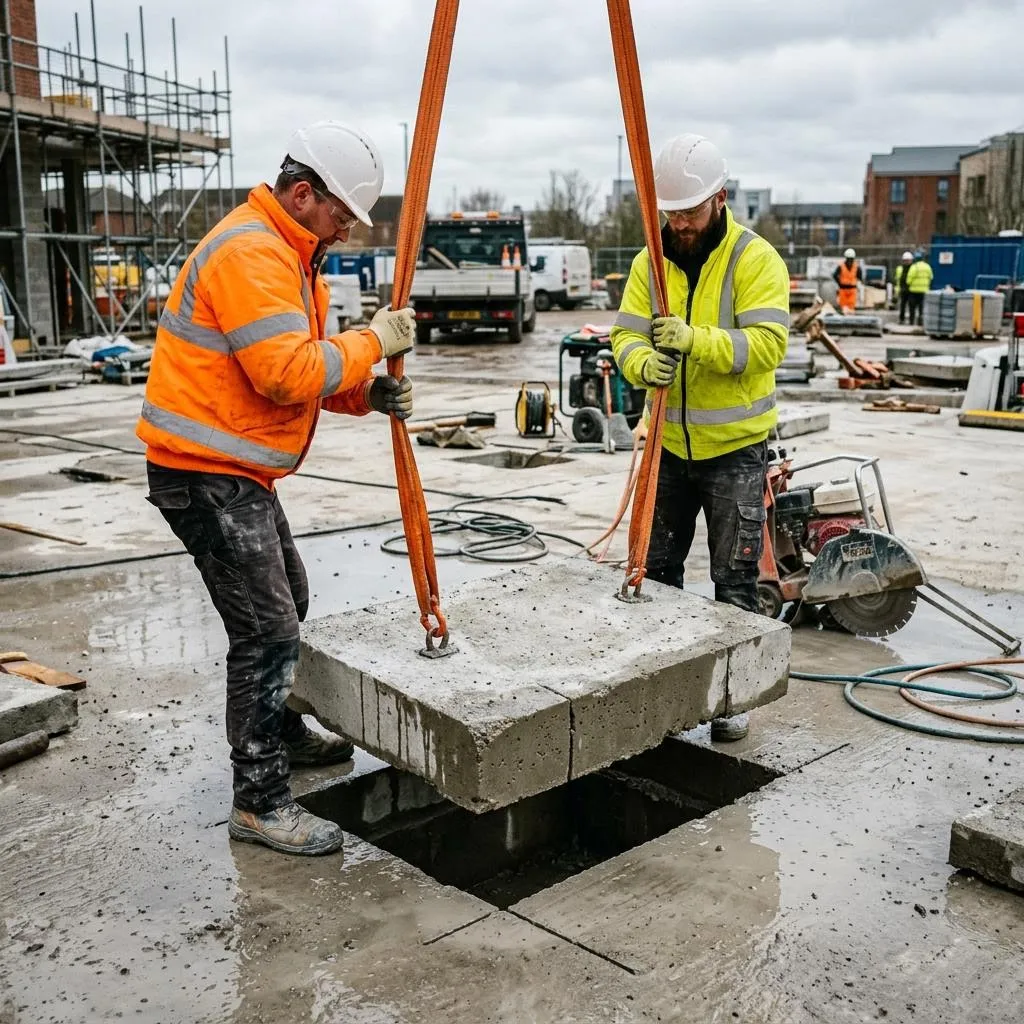
Floor sawing on floors that stay in use
A lot of floor sawing happens on live sites: a working warehouse, an occupied car park, a yard that still has to take deliveries. The cut has to fit around that.
We plan the sequence so an area is sawn, cleared and handed back rather than closing a whole floor at once. Slurry is contained inside a bunded zone so it does not spread onto trafficked areas, and cuts are timed to avoid the busiest periods where a client needs it.
If noise or access constraints affect when the sawing can happen, tell us up front and we will build the programme around them.
Keeping floor sawing clean and safe
Sawing concrete releases respirable crystalline silica. We saw wet, so the water feed suppresses the dust at the blade and carries the fines away as slurry.
We follow the control principles in the HSE silica dust guidance, construction information sheet CN8, which sets out water suppression, extraction and respiratory protection for this work. On enclosed floors we contain and collect the slurry so it does not run across the slab or into a drain.
Floor sawing for trenches, joints and slab removal
Most floor sawing falls into three jobs, and each has its own quirks worth understanding before the saw arrives.
Service trenches want two parallel cuts at the trench width so the ground between them breaks out cleanly, leaving a straight edge to reinstate against. Expansion and stress-relief joints want a single accurate cut to a set depth, timed and spaced to the engineer's detail so the slab can move without random cracking.
Slab removal wants the bays sawn into pieces sized to the plant that will lift them, whether that is a barrow, a mini digger or a grab. Cut the pieces too big and they cannot be moved. We plan that grid before the first cut so nothing ends up stranded on the slab.
Who we floor saw for
Floor sawing is groundworks and civils work as much as it is building work, so our clients cover both.
We saw for groundworkers cutting slabs and yards ahead of new drainage, for main contractors forming joints in new pours, and for civils teams working on roads, car parks and hardstanding. Facilities and maintenance teams use us to cut out failed slab bays for repair without disturbing the floor around them.
Our floor sawing process, step by step
We survey first, confirming access for the saw, power and water, the slab make-up and the depth of cut required.
We mark the cut lines to your drawing, scan where services could be in the path, then set the blade depth and saw wet along the line with slurry control in place.
For removal work we size the cuts so the pieces lift out cleanly, take them off the slab, and clean down so the trench or opening is ready for the next stage.
Where we carry out floor sawing in Essex
We cover Essex from Leigh-on-Sea, and much of our floor sawing is on industrial and commercial hardstanding.
That includes warehouse and yard slabs when we handle floor sawing in Southend-on-Sea, and drainage and service trenches on the distribution sites served by our team covering Grays and Thurrock. Basildon, Chelmsford, Rayleigh, Benfleet, Canvey Island and Brentwood are all within our normal working area.
Floor sawing FAQs
How deep can you saw into a slab?
A floor saw typically cuts to around 450mm to 500mm deep in a single pass, depending on the blade diameter and the machine. Deeper cuts are made by stepping down in passes, or by switching to a wall saw or wire where a floor saw runs out of depth.
Can you saw tarmac and reinforced concrete?
Yes. We floor saw reinforced concrete, mass concrete and tarmac, and the diamond blade cuts straight through mesh and reinforcement. The blade specification is matched to the material so the cut runs clean and true.
What is floor sawing used for?
Trenches for new drainage and services, expansion and stress-relief joints, cutting out damaged slab sections for repair, and dividing a slab into liftable pieces for removal. Anywhere a straight, controlled cut is needed in a horizontal surface.
How straight and accurate is the cut?
The saw runs on its own wheels along a marked line with a front guide, so the cut is straight and to a consistent depth. That accuracy matters for expansion joints and for trenches that have to line up with the drainage run.
Do you control the dust and water?
Yes. We saw wet, so the water feed suppresses the respirable silica at the blade and binds it into slurry. On enclosed slabs we contain and collect the slurry so it does not spread across the floor or reach a drain.
Need a slab, road or yard sawn in Essex?
Send the cut lines, the depth and the access. We survey before we quote and respond to every enquiry, usually the same working day.
Or send the details over
My Diamond Drilling Essex covers the county from our Leigh-on-Sea base.