Core drilling gives you the clean circular penetration a service needs to pass through a wall or floor: soil pipes, flues, ducting and cable runs. We drill the common bores of 52mm, 107mm, 127mm and 152mm across Essex, plus larger and smaller sizes to suit the job.
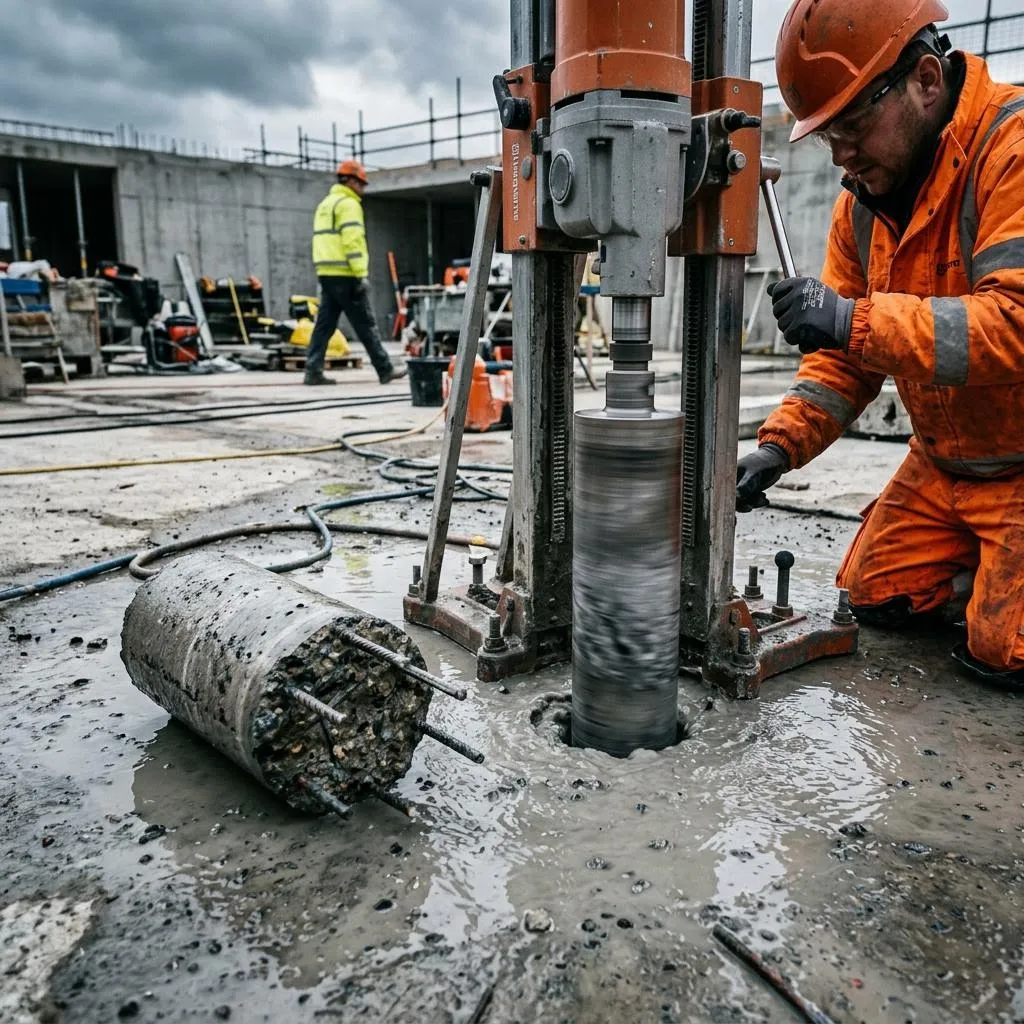
What is core drilling and how does it work?
Core drilling is the process of cutting a precise round hole so a pipe, duct, cable or flue can pass through the structure. A diamond-tipped barrel on an anchored rig cuts the material with water feeding the bore.
Think of the hole as the outcome and the diamond barrel as the tool. When a builder asks for a core, they mean the penetration itself, sized to the service that goes through it.
The wall of the bore comes out smooth and square, so the pipe seats properly and any sleeve, fire collar or making good sits neatly. That accuracy is what separates a cored hole from a hole knocked through with a breaker.
Core drilling or diamond drilling: which do you need?
They are two sides of the same work. Core drilling describes the everyday service penetrations, the medium bores that route drainage, mechanical and electrical services through a building.
Our diamond drilling Essex service covers the full range from 10mm fixings up to 1000mm ventilation cores, angled and overhead work, and rows of holes that form openings. If your job is a set of pipe and cable penetrations, this is the page you want. If it needs very large bores or forms part of an opening, start on the diamond drilling page.
When do you need core drilling?
Whenever a service has to cross a floor or wall cleanly. That is the short answer.
Plumbers use it for soil and waste pipes and for boiler condensate. Heating and gas engineers use it for boiler and biomass flues. Mechanical contractors core for refrigerant lines, extract and ventilation.
Electricians and data installers core for containment, tails and cable trunking. Where a bank of services drops through a floor slab, the work often ties into our riser openings for routing M and E services between storeys.
What can we core and to what size?
We core through reinforced concrete, mass concrete, engineering brick, blockwork, stone and masonry, including cavity walls drilled through in a single line.
The common diameters are 52mm for cabling and small pipe, 107mm and 127mm for soil and waste, and 152mm for larger waste and flue runs. Smaller pilot bores and larger cores for ducting are drilled to order. Depth is rarely the limit: barrels extend, so we core through thick walls and deep slabs.
Keeping core drilling clean and safe
Wet coring suppresses the respirable crystalline silica that dry cutting would throw into the air. The water feed binds the fines into slurry at the cutting face.
We work to the control principles in the HSE silica dust guidance, construction information sheet CN8, which sets out water suppression, extraction and respiratory protection. Slurry is captured at the hole with a collection ring and vacuum wherever a finished floor or occupied space is involved.
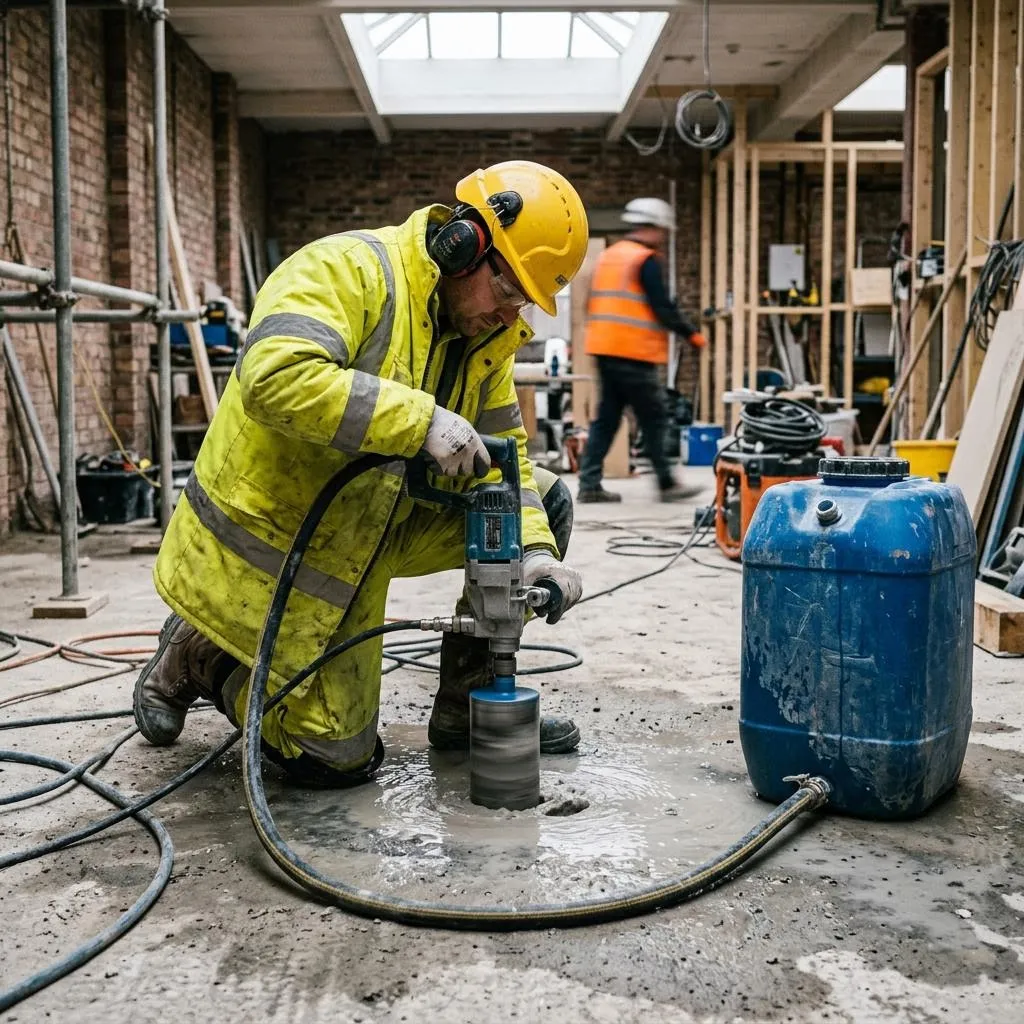
Sizing the core to the service
The single most common mistake we see is a core sized to the pipe rather than to the pipe plus its fittings. Get that wrong and the sleeve, collar or lagging will not pass.
A 110mm soil pipe wants a 127mm core so the pipe and any fire collar sit with clearance. A 40mm to 50mm waste run drops into a 52mm bore. A boiler flue is sized to the manufacturer's terminal, which is often larger than the flue pipe itself, so we confirm the terminal before we drill.
Refrigerant and condensate lines usually share a single tidy penetration rather than several scattered holes. Where a bank of cables runs together, a larger core with a grommet or intumescent sleeve beats a cluster of small ones. Tell us the service and we will confirm the bore.
Who we core drill for
Core drilling is fit-out and services work, so our clients are the trades that install through the structure.
We core for plumbers, gas and heating engineers, mechanical contractors, ventilation and refrigeration installers, electricians and data cabling firms. We also work for main contractors and shopfitters who need a full run of penetrations set out and drilled in one visit, and for facilities teams altering services in a building that stays occupied.
Our core drilling process, step by step
We survey first, confirming access, power, water, the material and the exact hole positions from your drawing or setting-out marks.
We scan the drilling zone where there is any risk of cutting critical reinforcement or a live service, then set out each core to those marks.
We anchor the rig, connect the water feed, cut the core and control the slurry. Then we remove the cores, clean down and leave each penetration ready for the pipe or cable to be run.
Where we carry out core drilling in Essex
We cover Essex from Leigh-on-Sea, and much of our coring is fit-out and refurbishment work in the busier towns.
That takes in core drilling in Southend-on-Sea for retail and residential refits, and core drilling in Rayleigh and the surrounding villages. Basildon, Chelmsford, Grays, Benfleet, Canvey Island and Brentwood are all inside our normal working area.
Core drilling FAQs
What is the difference between core drilling and diamond drilling?
Core drilling is what you are asking for: the finished circular hole for a pipe, flue, duct or cable. Diamond drilling is the method that produces it. In practice the terms overlap, but core drilling usually means the medium bores that route services through a floor or wall.
What size cores do you drill most often?
The everyday sizes are 52mm for cabling and small pipe, 107mm and 127mm for soil and waste, and 152mm for larger waste runs and flues. We also drill smaller pilot bores and much larger cores where the service demands it.
What hole do I need for a soil pipe?
A 110mm soil pipe usually passes through a 127mm core, which leaves clearance for the pipe and any sleeve or fire collar. Confirm the actual pipe and fitting size before you order, because a boxed collar can need a larger bore.
Can you core through a cavity wall for a flue?
Yes. We core the inner and outer leaves in line so the flue or extract runs straight through. The bore is sized to the flue plus any required clearance, and we keep the outer face clean so the finish is tidy.
How long does a single core take?
A 152mm core through a 300mm reinforced slab takes about twenty minutes once the rig is anchored. Setting out, scanning and rigging take longer than the cut itself, which is why a run of holes in one visit is far more efficient than isolated call-outs.
Do you collect the water and cores?
Yes. We use a collection ring and vacuum where slurry must not spread, and we remove the drilled cores from site unless you want them left. On overhead cores we control the water so it does not run back down the wall.
Need cores drilled for pipes or cables?
Send the bore sizes, the material and the number of holes. We survey before we quote and respond to every enquiry, usually the same working day.
Or send the details over
My Diamond Drilling Essex covers the county from our Leigh-on-Sea base.