Controlled demolition removes concrete structures in a planned sequence using bursting, crunching and cut-and-lift methods, with no percussive impact. We carry it out across Essex where a structure has to come apart quietly, safely and under control rather than being knocked down.
What is controlled demolition and how does it work?
Controlled demolition is the removal of a structure in a deliberate order, piece by piece, so the load path is managed the whole way down. Nothing is left to come apart by chance.
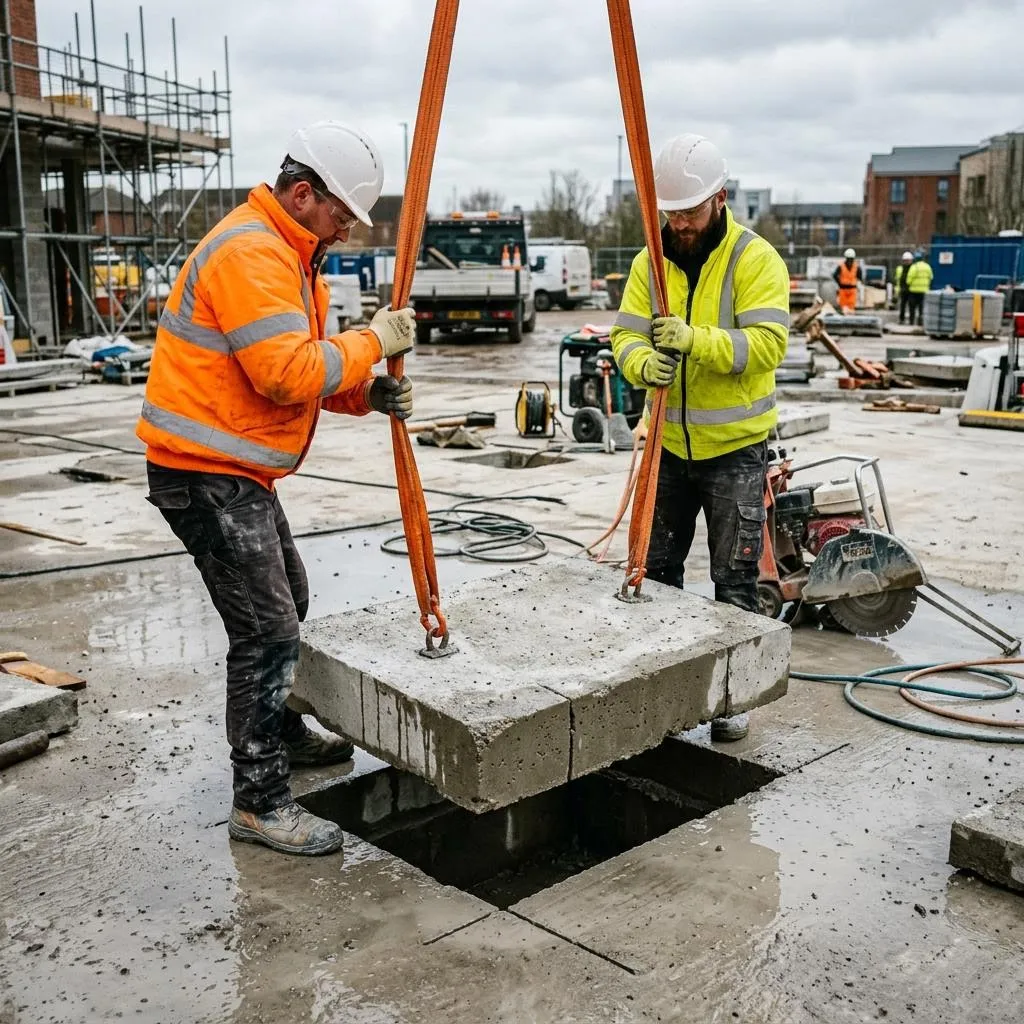
Rather than impact, it relies on splitting and shearing forces. Bursting cracks the concrete from inside drilled holes, crunching bites through it with hydraulic jaws, and cut-and-lift uses diamond cutting to free whole sections that are then lifted away intact.
The point is control. Each method is non-percussive and low vibration, so the surrounding structure and the buildings nearby are not shaken, and the work can be done in places where impact demolition would be unacceptable.
When do you need controlled demolition?
You need it whenever concrete has to be removed but impact demolition is out of the question. That is common in occupied and constrained settings.
Typical work includes removing floors, beams, columns, bases and staircases inside buildings that stay in use, cutting back structures next to sensitive neighbours, and taking out mass concrete foundations in tight yards. It also covers opening up structures where a full strip out is not wanted.
It is the method of choice near live services, occupied floors and party boundaries, where the low noise and low vibration keep the work possible without shutting the building or the neighbours down.
Controlled demolition methods: bursting, crunching and cut and lift
Hydraulic bursting splits concrete from within. A pattern of holes is drilled, bursters are inserted, and the hydraulic force cracks the section along controlled lines. It excels on thick, heavily reinforced mass concrete.
Crunching shears the structure with hydraulic jaws, cutting through concrete and reinforcement and processing the arisings into liftable sizes. Cut and lift uses diamond sawing to free complete sections that are craned or lowered out whole. For the deepest sections we bring in wire sawing for thick and heavy elements, which cuts where no blade can reach.
On most jobs these methods are combined. A base may be burst then crunched; a floor may be saw cut then lifted; a column may be wire cut then lowered. The mix is chosen to suit the structure, the access and how the material leaves site.
Keeping controlled demolition clean and safe
Diamond cutting within a controlled demolition is water cooled, so the dust from cutting concrete is suppressed at source and the respirable silica stays bound in slurry rather than airborne. Bursting and crunching are inherently low dust because they split rather than pulverise.
The recognised UK code of practice is BS 6187, which sets out how demolition is planned and carried out safely, including the removal sequence and keeping the structure stable throughout. We plan our controlled demolition in line with that approach and with the client's demolition and structural information.
Control of the structure is the priority at every stage. Sections are supported or restrained until they are cut free and lifted, temporary works are the client engineer's responsibility and must be in place before we start, and nothing is removed until it is clear where it is going.
Our controlled demolition process, step by step
First we survey and plan. We assess the structure, the reinforcement, the access and the load path, and agree the removal sequence and how the arisings leave site.
Next we set up the method. Holes are drilled for bursting, cut lines are marked for sawing, and the machines for crunching or lifting are positioned for the sequence.
Then we remove the structure in order. Each element is split, cut or sheared and taken out in planned pieces, with the remaining structure kept stable and supported throughout.
Finally the arisings are cleared, the area is cleaned down, and the site is handed back at the stage the works require. Where remote machines suit the space, this runs alongside our Brokk demolition for confined spaces.
Where we carry out controlled demolition in Essex
We work across Essex from our base in Leigh-on-Sea, covering the coastal towns, the Thames-side industrial areas and the county towns inland.
Southend, Basildon, Chelmsford, Grays, Rayleigh, Benfleet, Canvey Island and Brentwood are all within our normal working area, along with the towns in between. Refurbishment and structural alteration work, where concrete has to come out of a building that stays in use, keeps controlled demolition in steady demand across the county.
Controlled demolition FAQs
What is controlled demolition?
Controlled demolition removes a concrete structure in a planned, piece-by-piece sequence rather than knocking it down. Instead of breakers and impact, it uses bursting, crunching and cut-and-lift methods so the element comes apart quietly, with low vibration, and under control at every stage. It suits occupied buildings and tight sites where impact demolition is out of the question.
What is hydraulic bursting?
Bursting drills a pattern of holes into the concrete, then inserts hydraulic bursters that exert enormous splitting force from inside the holes. The concrete cracks apart along predictable lines with no impact and very little noise. It is ideal for splitting mass concrete, thick bases and heavily reinforced sections into manageable pieces.
What is concrete crunching?
Crunching uses hydraulic jaws, mounted on a machine, that bite through concrete and shear the reinforcement. It processes broken material into sizes that can be handled and removed. Crunching is quiet compared with impact demolition and gives close control over where and how the structure comes apart.
Is controlled demolition really quieter than knocking it down?
Yes, considerably. Because the methods are non-percussive, there is no repeated hammer impact, so noise and vibration are far lower than breaker or ball demolition. That is precisely why it is chosen for work near occupied buildings, sensitive structures and neighbours who cannot tolerate impact.
Do you follow a demolition standard?
The recognised code of practice for demolition in the UK is BS 6187, which sets out how demolition should be planned and carried out safely, including the sequence of removal and the control of the structure throughout. Our controlled demolition work is planned in line with that approach and with the client’s demolition and structural information.
Need concrete removed without the impact?
Tell us what needs taking out, the access and how the material leaves site. We respond to every enquiry, usually the same working day, and we survey before we quote.
Or send the details over
My Diamond Drilling Essex covers the county from our Leigh-on-Sea base.