Concrete scanning uses ground penetrating radar and ferroscanning to find the reinforcement, cables and live services hidden inside a slab or wall before anyone drills into it. We scan across Essex so the setting out avoids a strike, not just to tick a box.
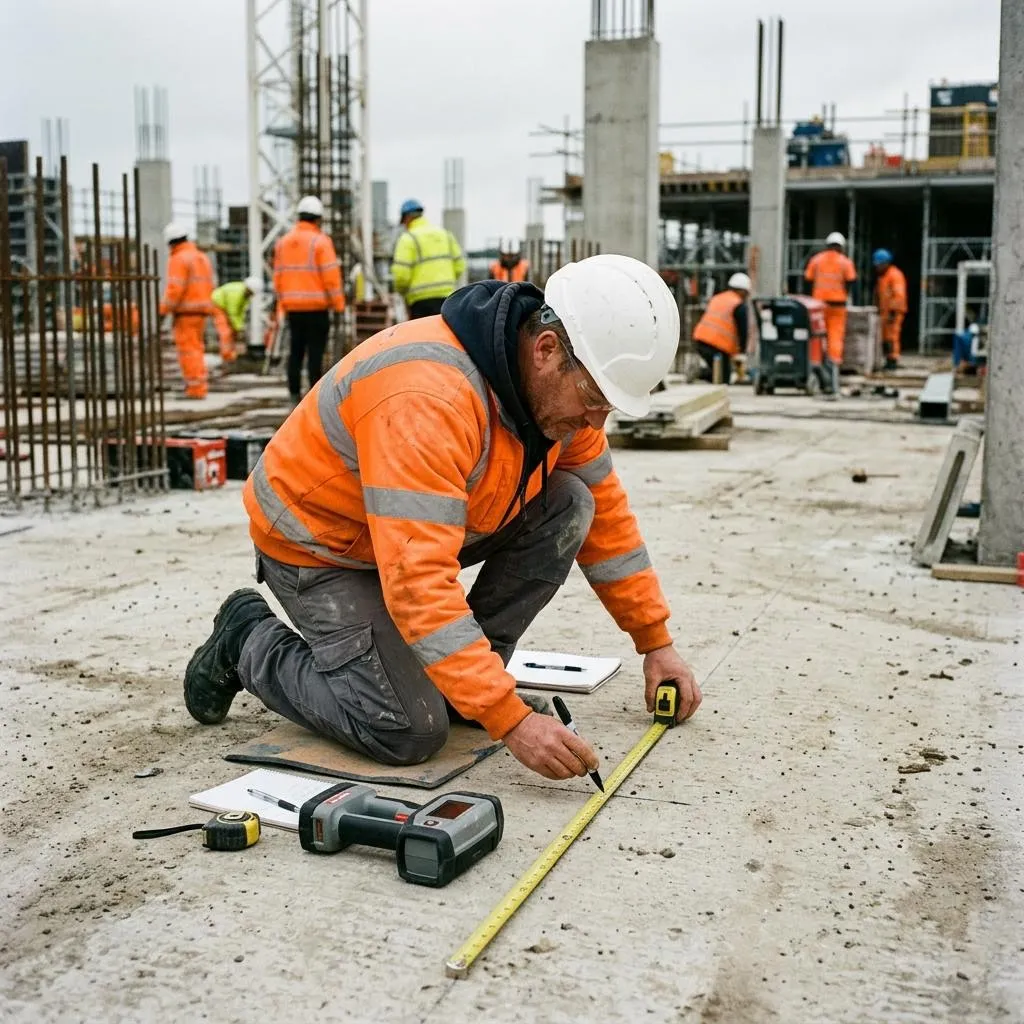
What is concrete scanning and how does it work?
Concrete scanning is a non-destructive survey of what sits inside a structure. It reads the concrete from the surface and maps the steel, services and features hidden below without cutting anything open.
Ferroscanning uses electromagnetic induction to locate steel and measure the cover over it, which is ideal for mapping reinforcement quickly. Ground penetrating radar sends pulses into the slab and reads the reflections, so it picks up conduit, voids, post-tension tendons and layered reinforcement as well as steel.
We choose the method, or combine both, to suit the material and what we are looking for. The output is a marked-up surface: bars, services and safe drilling zones drawn straight onto the wall or floor.
How concrete scanning prevents strikes
The single biggest fear on any drilling job is hitting something you should not: a structural bar, a post-tension cable, a live electrical cable, a water main or a data run. Scanning is how that fear is answered directly.
A service strike stops the job, and the consequences run from a flooded floor to a cable fault to a genuine danger to the operative. Cutting a critical reinforcement bar can weaken the very element you are working on. None of that shows on a set of record drawings.
Scanning first is simply cheaper and safer than finding out with the barrel. That is why we treat it as standard before we My Diamond Drilling Essex carries out diamond drilling through reinforced concrete, rather than as an optional extra bolted on when someone gets nervous.
What can we scan, and to what depth?
We scan reinforced concrete slabs and walls, post-tensioned slabs, mass concrete, screeds and masonry. The practical depth depends on the method, the material density and the size of the target.
Ferroscanning is best for near-surface reinforcement and cover measurement. Ground penetrating radar reaches deeper and is the method for thicker slabs, post-tension detection and picking up non-metallic services that a ferroscanner will miss entirely.
We set the realistic detection depth out with you before we start, because promising a reading the physics will not deliver helps nobody. Where a slab is thicker than a single method can see through, we scan from both faces if access allows.
Keeping the site clean and safe with scanning
Scanning itself is non-destructive, so it creates no dust and no slurry. Its whole purpose on the safety side is to make the drilling that follows safer and cleaner, by keeping the barrel away from services and by keeping the job running without the disruption a strike causes.
When we move from scanning to drilling, the dust from cutting concrete is controlled with wet suppression in line with the HSE guidance on silica dust, construction information sheet CN8. Scanning and dust control together mean the work is planned rather than reactive, which is safer for everyone on site.
Where a scan flags something the drawings did not, we stop and agree the next step with you before any hole is committed. A revised setting out on the wall costs minutes. An unplanned strike costs a great deal more.
Our concrete scanning process, step by step
First we agree the scope. We confirm what you need to find, the drilling or cutting positions, the material and the access, and whether the slab may be post-tensioned.
Next we scan the area. We run the ferroscanner, the radar, or both across the zone, reading the returns as we go and building up the picture of what sits inside.
Then we mark up the surface. Reinforcement, services, safe zones and no-go areas go straight onto the wall or floor so the driller works to marks, not to a report.
Finally we hand over or drill. On a scan-only job we record depths and cover where the method allows. On our own jobs we set out clear of the marked services before we core drill the penetration to size.
Where we carry out concrete scanning in Essex
We scan across Essex from our base in Leigh-on-Sea, on our own drilling work and on its own for other contractors and engineers.
Southend, Basildon, Chelmsford, Grays, Rayleigh, Benfleet, Canvey Island and Brentwood are all within our normal working area, along with the towns in between. Fit-out, refurbishment and structural investigation work keep scanning in steady demand across the county.
Concrete scanning FAQs
What does concrete scanning actually detect?
Ferroscanning maps steel: reinforcement bars, mesh and the cover over them. Ground penetrating radar goes further and picks up plastic and metal conduit, voids, post-tension cables and changes in the slab, as well as steel. Between the two methods we build a picture of what sits in the concrete before anyone drills into it.
Why scan before drilling if the drawings show the rebar?
Because drawings show the design intent, not what the gang actually poured fifteen or forty years ago. Bars move during a pour, extra reinforcement gets added, services get chased in later and none of it makes the record drawings. Scanning shows the reality on the day, which is the only thing that stops a strike.
Can scanning find post-tension cables?
Ground penetrating radar can identify the tendons and ducts in a post-tensioned slab. Cutting a live post-tension cable is dangerous and expensive, so on any slab suspected of being post-tensioned we scan first and set the drilling out clear of the tendon zones.
How accurate is the scan and how is it marked up?
We mark the findings straight onto the surface: bar positions, service runs, safe zones and no-go areas, so the driller works to what is drawn on the wall or floor, not a report left in the van. Depth and cover are recorded where the method allows it. The accuracy depends on the material and the target depth, which we set out before we start.
Do you scan as part of a drilling job or on its own?
Both. On our own drilling and cutting we scan as standard wherever there is any risk. We also scan on its own for other contractors and engineers who want the concrete checked before their own works, whether that is drilling, fixing or a structural investigation.
Want the concrete checked before you drill?
Tell us where you need to cut and what you are worried about hitting. We respond to every enquiry, usually the same working day, and we scan before we cut.
Or send the details over
My Diamond Drilling Essex covers the county from our Leigh-on-Sea base.