The single question that decides whether a cored hole works or has to be redone is the diameter. Too tight and the pipe will not seat or there is no room to fire-stop around it. Too loose and you have a bigger opening to make good than the job needed. Getting the core drill diameter right up front is worth a few minutes of arithmetic before the barrel goes in.
This runs through how to work out a sensible finished diameter for pipes, flues and ducts, and the allowances that people forget.
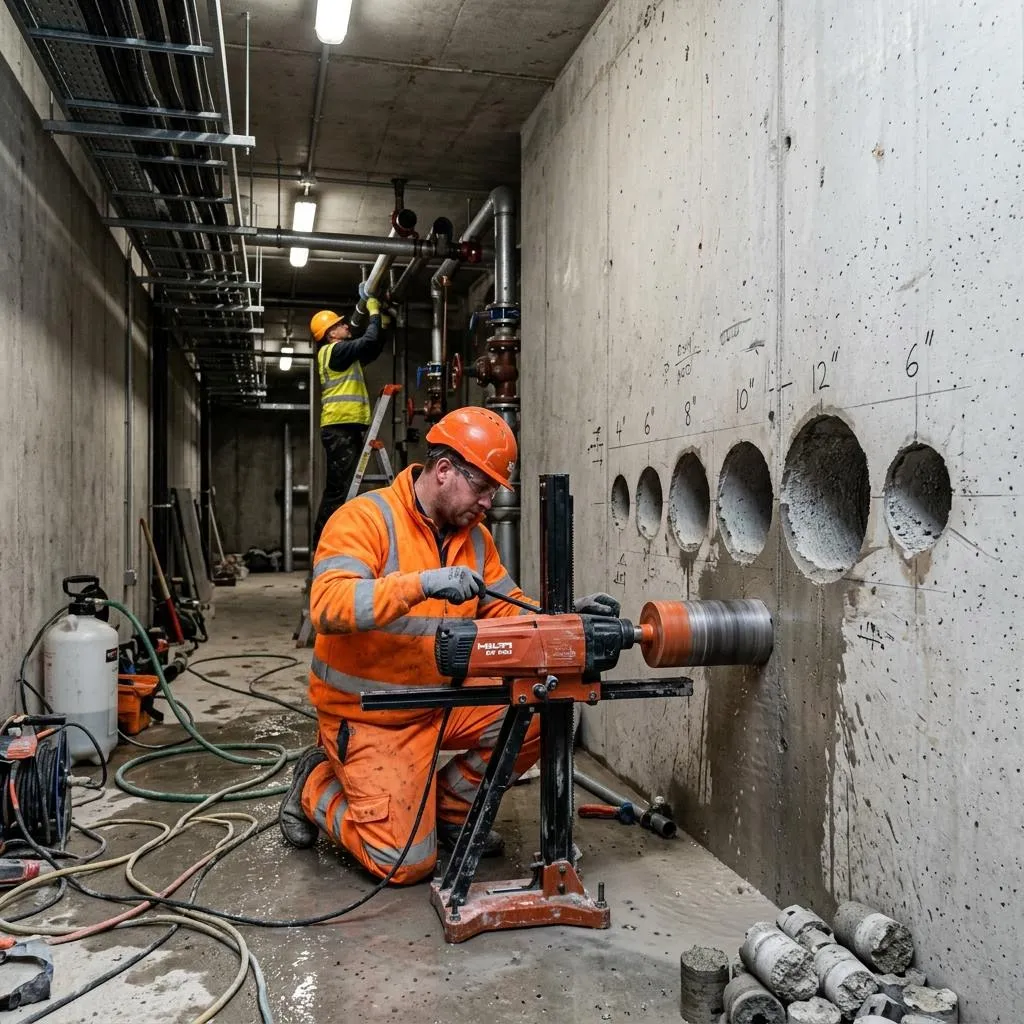
Start with the service, not the barrel
The mistake is to think in barrel sizes. Think in terms of what has to pass through the hole and what has to sit around it. A core barrel is described by its nominal diameter, and common sizes step up in useful increments: 52mm, 107mm, 127mm, 152mm and up. The right choice is the one that leaves the service seated with the correct gap around it, not simply the one closest to the pipe's outside diameter.
So the order of thinking is: what is the service, what goes around it, and what gap does the detail need. Then pick the barrel that gives you that finished opening.
Allowing for sleeves, insulation and fire collars
A bare pipe outside diameter is rarely the number you drill to. Where a pipe passes through a fire-rated wall or floor it usually needs a fire collar or an intumescent wrap, and that sits inside the hole around the pipe. A duct may carry insulation that has to pass through unbroken. A pipe may run in a sleeve so it can move without loading the structure.
Each of those adds to the diameter you need. A 100mm pipe with a fire collar can want a 150mm-plus core once the collar and the annular gap are counted. Miss the collar allowance and you core a hole that is exactly the wrong size: too small for the detail, too committed to change cheaply. Ask the mechanical or fire-stopping detail what the finished annulus should be before you settle on a barrel.
Flue diameters and clearances
Flues bring their own rule: the clearance to combustibles. A flue liner has a required distance to any combustible material, and the core has to respect that rather than just clear the liner's outside diameter. On a raked flue the geometry changes again, because a sloped core presents an oval to the wall face. Angled flue penetrations are their own small discipline, covered in angled and overhead core drilling, and the diameter needs setting with the angle in mind, not after it.
When one core is not enough
There is a ceiling to how big a single core is practical before the barrel, the motor and the anchoring make it awkward. Large ventilation penetrations can run to several hundred millimetres, and at that point the question becomes one big core or a formed opening. Where the opening is too large or the wrong shape for a single barrel, it is formed with overlapping cores instead, which is the subject of drilling reinforced concrete where rebar density often decides the approach.
For a run of services stacked up a building, the diameters are usually set out together so the openings line through floor to floor. That is typical riser openings work, where the sizes are agreed off the mechanical layout before anyone drills, so every core lands where the duct or pipe actually needs it.
Getting the setting out right
Diameter is only half the job. Position matters just as much, especially with several cores close together, because a barrel that is a touch off line can clip its neighbour or foul a reinforcing bar. Marking out carefully, checking the diameters against the services list, and scanning the concrete first all belong to standard core drilling practice. The broader picture of which drilling method suits which job is set out in our overview of the types of diamond drilling, and diameter selection is the detail that makes any of them land right.
A quick working checklist
Before committing a barrel, run through it: outside diameter of the service, plus any sleeve, plus insulation, plus the fire collar or wrap, plus the annular gap the detail asks for. Then pick the next sensible barrel size up. Check the position against anything else passing through the same face, and confirm the material and thickness so the barrel and segments suit it.
If you send over the services list and the wall or slab details, working out the right diameters is exactly the sort of thing My Diamond Drilling Essex sorts out at quote stage, so the cores land the right size the first time and there is nothing to make good that the job did not need.