Not every core goes straight down through a slab or straight through a wall at a comfortable working height. Plenty go up into a soffit, out at a rake for a flue, or into an awkward corner where the rig cannot sit square. Angled and overhead core drilling is the same barrel and the same motor, but the setup, the water handling and the safety thinking all change.
This is a look at what actually differs once the hole stops being vertical and easy, written from the point of view of the person setting the rig up on site.
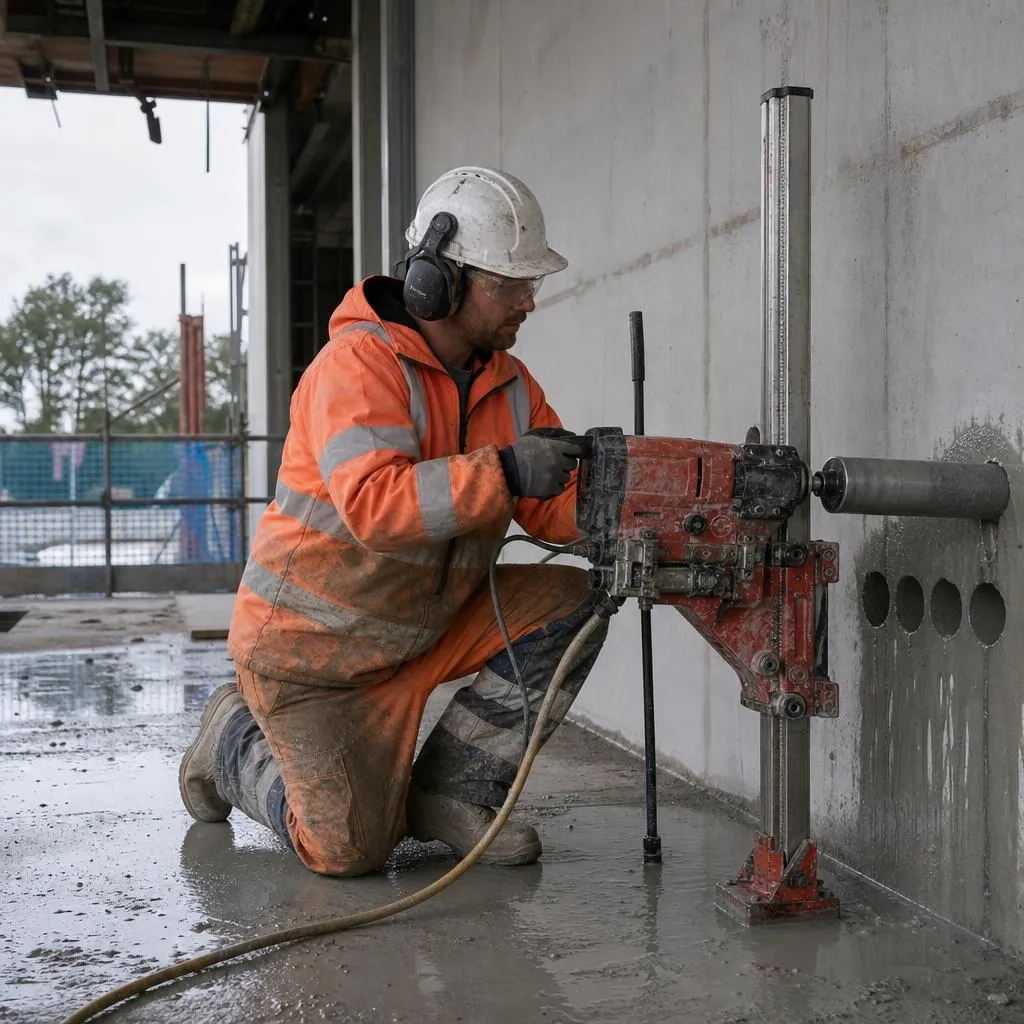
What counts as angled core drilling
Angled core drilling means the barrel is fed at a set angle rather than square to the face. It comes up for raking flue runs, drainage falls, cable routes that have to clear an obstruction, and connections where a pipe meets a wall on the slant. The angle is not guessed. It is set on the rig and held for the full depth so the bore stays true from entry to break-through.
The trouble with an angle is that the barrel wants to walk at the start. Before the diamonds have bitten a full ring, a raked bore can wander off line. So the rig has to be anchored hard and the entry started slow, with a light feed until the barrel is fully engaged. Get the first ten millimetres right and the rest follows the line you set.
Overhead core drilling into soffits and beams
Overhead work is coring up into a soffit, a downstand beam or the underside of a floor slab, usually for services dropping from the level above. It is common in plant rooms and risers where a duct or pipe has to pass up through a slab that you are working under.
The obvious problem is water. On a downward core the slurry drains away from you. Overhead, it wants to run straight back down the barrel, over the motor and onto the operator. So overhead coring uses a water swivel and a collection system that catches the slurry at the bore and takes it away by vacuum rather than letting it fall. It slows the job down a little, and it is not optional.
The second problem is the core itself. On a through-slab overhead core the cut cylinder can drop as it releases. That has to be controlled so a lump of concrete does not fall onto the rig or the operator, which means planning the catch before the barrel breaks through.
Anchoring and keeping the bore true
Everything above depends on the rig staying put. Angled and overhead cores put load on the anchors in directions a simple vertical core does not, so the fixing has to suit the pull. A rig that shifts mid-core gives a bore that binds the barrel and a hole that is out of line.
Where a rig genuinely cannot be anchored to suit, the honest answer is to change the approach rather than force it. That might mean a different anchor pattern, a bracing arrangement, or setting out from a face that does give a solid fixing. The method follows the structure, not the other way round. The broad rules of setting a barrel true are covered in our overview of the types of diamond drilling, and angled work is really that discipline applied at a harder angle.
Choosing wet working on awkward cores
Angled and overhead cores are almost always run wet. Water cools the segments, flushes the cuttings and binds the fines so respirable silica is not thrown into the air, which matters more when you are working directly under the bore. Where a fully dry core is unavoidable, the trade off in dust control is significant, and that balance is the whole subject of our guide to wet vs dry core drilling.
The dust from concrete is a controlled health risk, not a nuisance. The HSE construction information sheet CN8 on silica dust sets out water suppression, extraction and respiratory protection as the control measures, and overhead work is exactly where cutting corners on that shows up fastest.
Getting the diameter right first
A raked or overhead core is harder to redo, so it is worth being sure of the diameter before the barrel goes in. The bore has to clear the pipe, flue liner or duct plus its sleeve, insulation or fire collar, and on an angle the effective opening the service sees is slightly different from the nominal barrel size. Working the finished sizes out in advance is covered in choosing core drill diameters, and it saves reworking a hole you would rather cut once.
When this comes up on a job
Angled and overhead cores turn up most on mechanical and electrical work: flue penetrations, duct drops, drainage connections and service routes through occupied buildings. Most of it is standard core drilling work with the setup adapted for the position. The barrel and the motor do not care which way up they are. The care goes into the anchoring, the water capture and controlling the core as it releases.
If you have got cores going into a soffit or out at a rake and you want a clean, controlled result, that is bread and butter for My Diamond Drilling Essex, working across the county from a Leigh-on-Sea base. Send the angles, the diameters and the material and we will tell you how we would set it up.