Wet and dry are the two ways of running a core barrel, and the choice is not a matter of preference. Each suits different materials and different positions, and picking the wrong one shows up as a slow cut, a mess on the floor or a barrel that dulls before its time.
Here is how the two methods of core drilling actually differ on site, and how the decision gets made before the rig is anchored.
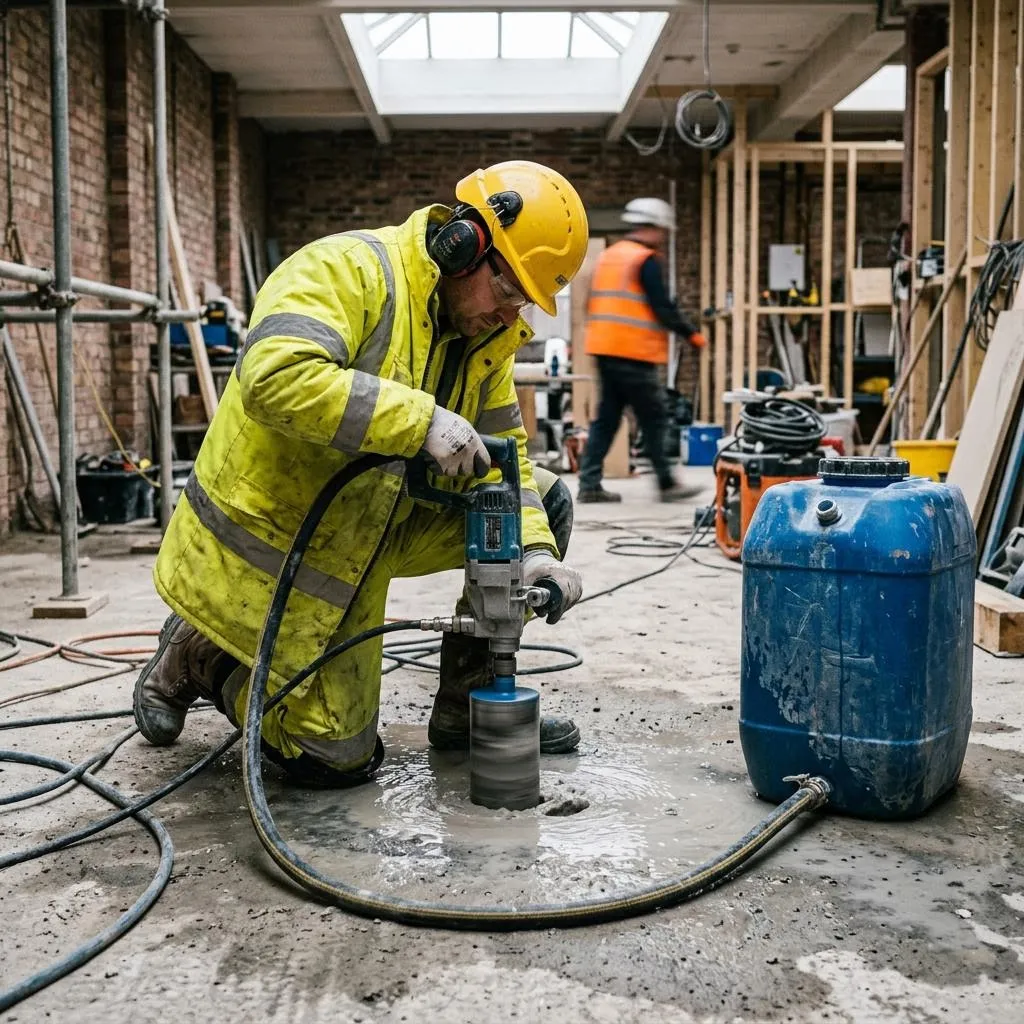
What wet core drilling does
Wet coring feeds water down the barrel while it cuts. The water does two jobs at once. It cools the diamond segments so they last, and it flushes the swarf out of the bore and binds the fine dust into slurry.
That dust matters. Cutting concrete releases respirable crystalline silica, which is a controlled health risk, not a nuisance. The HSE sets out water suppression as a primary control in its construction information sheet CN8, and wet coring is the straightforward way of meeting it on concrete work.
The trade-off is water. It has to go somewhere, and on a finished floor or in an occupied building that means a collection ring and a vacuum at the hole so slurry does not run across the room.
What dry core drilling does
Dry coring runs the barrel without water and pulls the dust away with an extraction vacuum instead. It is the method for materials that must stay dry, such as some brickwork, or positions where water simply cannot be allowed to run, like drilling above a live electrical panel.
Dry work leans harder on extraction to keep the silica down, and the barrel runs hotter, so it is generally kept to shorter cuts and softer materials. Push a dry barrel through a deep reinforced slab and it will overheat and glaze.
Which method suits the job
The material decides most of it. Reinforced concrete, dense slabs and deep cores nearly always call for wet drilling, because the cooling keeps the segments cutting and the slurry handles the fines. Shallow holes in masonry, or positions where water is a hazard, lean dry.
The position decides the rest. If there is anything below the hole that water would damage, or the floor finish cannot take slurry, that pushes the method towards dry with strong extraction, or wet with a sealed collection ring. We work this out at the survey, not on the day.
This is one of several method choices that sit under the broader picture in types of diamond drilling. It is worth reading if you want the full range before you settle on an approach.
Where the method interacts with the material
Reinforcement changes the calculation again. A wet barrel cuts through rebar cleanly because it stays cool, whereas a dry barrel struggles once it meets steel. If your section is heavily reinforced, wet is almost always the answer, and the reasoning is covered in drilling reinforced concrete.
The method also feeds into how openings are formed. When a run of overlapping cores makes an opening, they are almost always cut wet for the same cooling and dust reasons, as set out in stitch drilling explained.
Finish, mess and making good
Both methods leave a clean, round hole with a smooth wall, so making good is minimal either way. The difference is the mess during the cut. Wet work produces slurry that must be contained. Dry work produces fine dust that must be extracted at source rather than allowed to settle.
On an occupied site, neither is acceptable uncontrolled. That is why we agree slurry handling or extraction before the barrel starts, so the handover is tidy whichever method the job calls for.
The short version
Wet for concrete, depth and reinforcement. Dry for masonry, short cuts and places water cannot go. Most concrete work on an Essex site ends up wet, with a collection ring where the floor demands it. When it is not obvious, the survey settles it.
If you have a run of cores coming up and you are not sure which method fits, put the details in front of the team at diamond drilling Essex and we will tell you what suits the material and the position before anyone turns up.