Stitch drilling is how an opening gets formed when a saw cannot reach and a single core is nowhere near big enough. Instead of one hole, you drill a line of overlapping cores, each one breaking into the last, until the run joins up into a full opening.
The name comes from the pattern. The cores sit side by side like stitches, and where they overlap the concrete between them is removed cleanly. Here is how the method works and when it beats the alternatives.
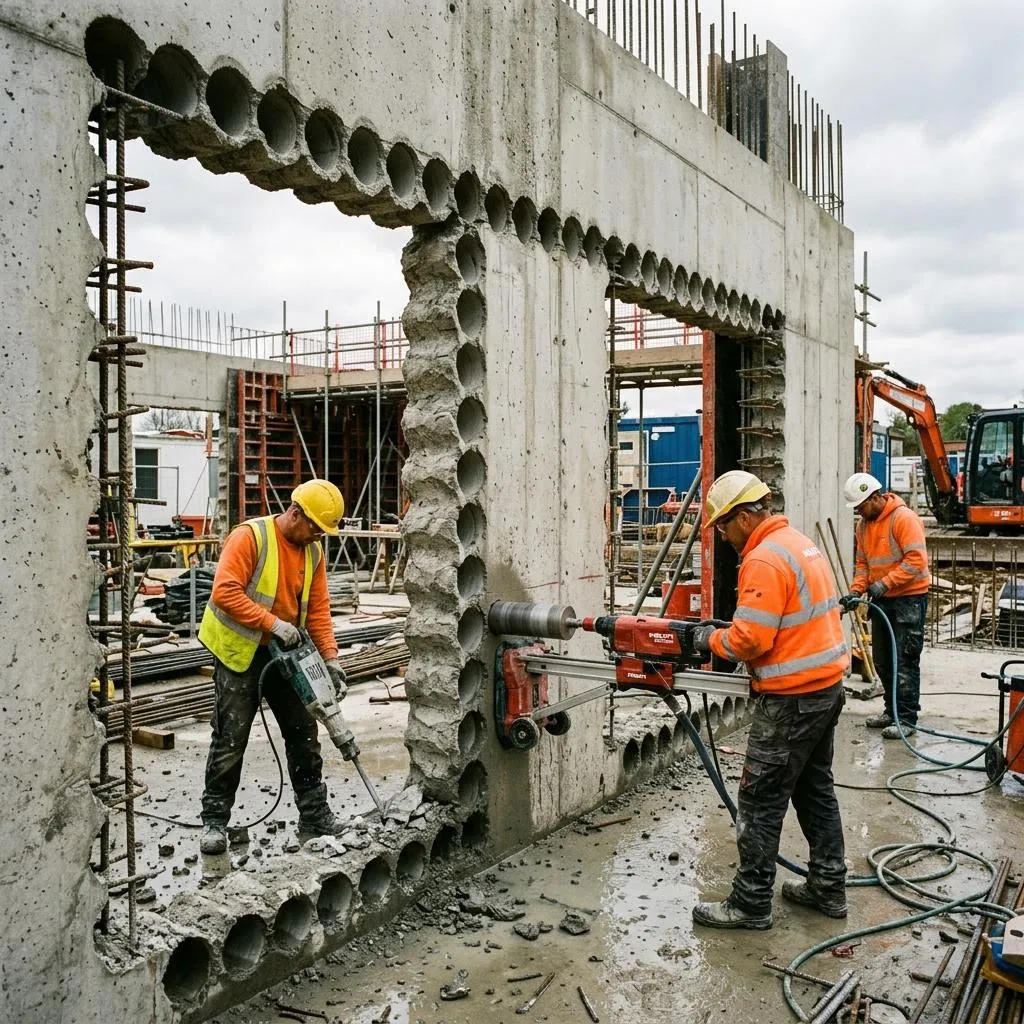
How stitch drilling forms an opening
You mark out the opening, then drill a row of cores along its edges so each core cuts into its neighbour. The overlap is what does the work: it removes the sliver of concrete that would otherwise be left between two touching holes, leaving a continuous cut line.
Run cores along all four sides and the middle drops out as a block, broken down for removal. The result is a rectangular opening with a square, defined edge, formed without a saw ever running across the face.
When stitch drilling beats a saw
A wall saw is quicker where it can run, but it needs clearance, a flat face and a manageable depth. Take any of those away and stitch drilling takes over.
It reaches into corners a blade cannot finish. It cuts sections far thicker than a saw blade can reach, because the barrel goes as deep as the drill will feed. And it works in tight, occupied spaces where a large saw simply will not fit. Where an opening is too large or awkward for a core or a saw, stitching is the answer, as noted in types of diamond drilling.
Setting out the overlaps
The finish lives or dies on the setting out. Space the cores too far apart and you leave nibs of concrete on the edge that need chasing off. Overlap them too much and you drill more holes than the job needs, which costs time.
The overlap is set against the diameter so each core bites into the last by a consistent amount, giving a clean line without waste. On a reinforced section the setting out also has to account for the steel, which is why scanning and a considered layout go together.
Wet cutting and dust control
Stitch cores are almost always cut wet. The depth and the volume of concrete removed generate heat and fines, and water keeps the segments cool while binding the silica dust into slurry. The reasoning is the same as any deep core, which we set out in wet and dry core drilling.
On an occupied building the slurry is caught and cleared as it is produced, so a large opening does not leave a large mess behind it.
Sequence and support
On a structural opening the order the cores come out matters. You are removing material from a wall or slab that is carrying load, so temporary propping and the drilling sequence are agreed against the engineer's design before a barrel starts. The opening is formed in a way that keeps the surrounding concrete stable throughout.
Because the work is non-percussive and low vibration, it suits occupied buildings and sensitive structures far better than breaking out. Nothing gets hammered, so the risk of cracking the section you are keeping stays low.
Where it fits on real jobs
Stitch drilling forms doorways, hatches, plant openings and service penetrations through thick walls and slabs. It suits the situations where a clean edge matters and the structure around the opening has to stay intact and low-vibration.
It is a core part of how we form stitch drilling openings and the wider structural openings work, where the opening has to be cut without disturbing the load path more than necessary. On structural work the setting out is agreed against the design before anything is drilled.
The short version
Stitch drilling turns a line of round cores into a square opening. It is slower than a saw but reaches where a blade cannot, handles thick sections and holds a clean edge. The skill is in the overlap and the setting out, not the drilling itself.
If you have an opening to form and a saw will not reach it, describe the wall and the size to My Diamond Drilling Essex and we will tell you whether stitching is the right way to cut it.